What the White Desert actually is
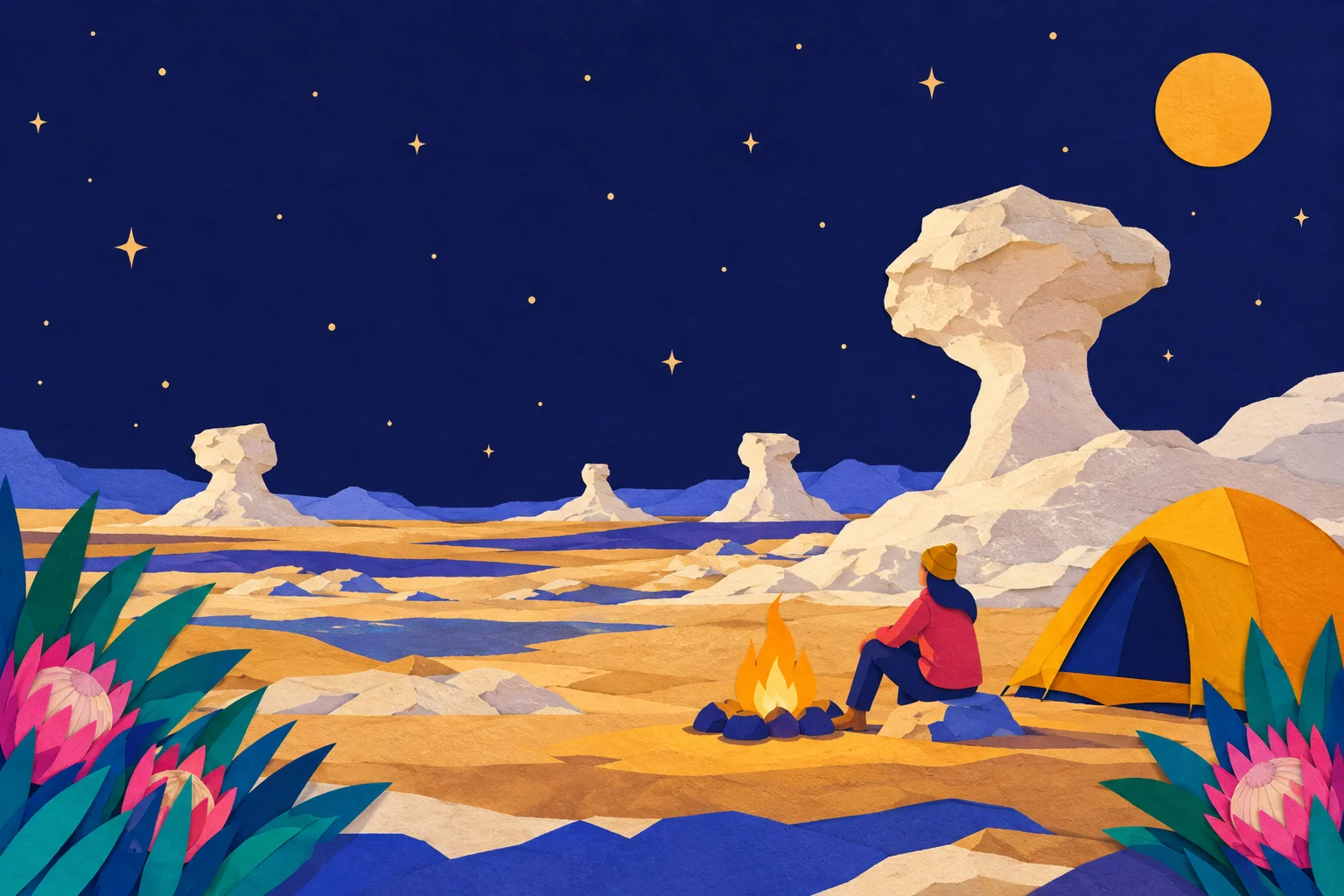
The White Desert is a protected national park of chalk rock formations — mushroom-shaped pillars, the "chicken and tree" cluster, and wide white floors that turn pink at sunset. It sits on the Farafra road, roughly 45 km north of Bawiti, the main town of Bahariya Oasis. The park was declared a national park in 2002, and camping inside it is only allowed with a licensed guide.
It is not the same as the Great Sand Sea further west, and it is not Siwa. If you were weighing up the western oases, our Siwa Oasis guide covers the salt lakes and the oracle, and the two trips are usually done separately, not combined.
Getting there: Bahariya first
Almost every White Desert trip starts in Bawiti. You reach Bahariya by:
- Private car or minibus from Cairo — around four to five hours on the Cairo–Fayoum–Bahariya road.
- Public bus from Cairo — the long-distance buses from Cairo Gateway (Turgoman) run to Bawiti; check departure times locally, as schedules shift.
- Organised tour from Cairo — the simplest option if you have two or three days and no car.
Once in Bawiti, the desert itself is reached by 4x4. Ordinary cars do not go into the park.
What a standard overnight tour includes
Most operators in Bawiti run the same loop. A typical two-day, one-night itinerary looks like this:
| Stop | What it is | Time there |
|---|---|---|
| Black Desert | Volcanic dark hills and dolerite ridges | 30–60 min |
| Crystal Mountain | A ridge of quartz crystal beside the road | 20–30 min |
| Valley of Agabat | White chalk valley with yellow sand | 30–60 min |
| White Desert | Chalk formations, sunset, camp | Overnight |
| Return via Bahariya | Back to Bawiti | Morning |
A three-day version usually adds the hot springs at Bir Sigam or Bir El Ghaba, and sometimes a longer drive towards Farafra.
Costs and what to agree before you go
Prices in Bawiti are quoted per vehicle, not per person, and they move with fuel prices and season. Ask for a written breakdown before you pay a deposit. Confirm:
- Whether the park entry fee is included or paid separately at the gate.
- Whether meals, water and bedding are included.
- The exact vehicle (a 4x4, not a minibus).
- The guide's licence number — park rules require a licensed guide.
- Whether the camp is a fixed tented camp or a temporary one pitched for your group.
Bring Egyptian pounds in cash. There are ATMs in Bawiti, but they run out, and no one in the desert takes a card. Our Egypt currency guide explains cash, small notes and baksheesh in more detail.
When to go
October to April is the comfortable window. December and January nights in the desert drop close to freezing, so bring a proper layer even if the day was 25°C. May to September is genuinely hot, and some operators reduce or pause trips in high summer. For a month-by-month view of the country, see Egypt weather.
Staying connected in the Western Desert
This is the part most guides skip. Mobile coverage in Bahariya town is patchy but workable; coverage inside the White Desert park is not something to rely on. Treat the desert as offline.
What actually helps:
- Download offline maps before you leave Cairo. Google Maps and Maps.me both allow offline areas; download the Bahariya and Farafra tiles while you still have signal.
- Screenshot your bookings and your guide's phone number. You will not be able to look them up later.
- Tell someone your itinerary. Hotel name in Bawiti, guide name, expected return time.
- Keep a power bank. Desert camps rarely have reliable charging, and cold nights drain phone batteries faster.
- Use an eSIM for the Egypt leg. An eSIM activates before you fly, so you land with data already working and no queue at the airport counter. Our eSIM Egypt guide covers plans, coverage and the data rules, and Cairo Airport SIM card explains the counter alternative if you prefer a physical SIM.
If you are combining Egypt with Morocco or South Africa on the same trip, a single regional plan can cover all three — see Africa eSIM.
What to pack for the night
- Warm layer, hat and socks for the evening — desert nights are cold even in spring.
- Head torch or a small torch.
- Toilet paper and hand sanitiser.
- Refillable water bottle; two to three litres per person per day.
- Sunscreen and sunglasses; the white chalk reflects hard.
- A light sleeping bag liner if you are picky about bedding.
Practical rules
- Do not climb the formations. They are fragile chalk and the park fines damage.
- Take all rubbish back to Bawiti.
- Photography of military or police installations is not allowed anywhere in Egypt; if in doubt, do not raise the camera.
- Women travellers report the desert camps themselves are relaxed; the usual Egyptian advice about dress and attention applies in Bawiti. See Egypt travel tips for the wider picture.
How it fits into a longer Egypt trip
Most people do the White Desert as a two-night add-on from Cairo, either at the start or the end of a Nile itinerary. If you are heading south afterwards, Egypt trains explains the Cairo–Luxor sleeper, and Luxor SIM card covers buying data once you are there. If you are staying in Cairo first, Cairo covers the museum, the metro and the traffic.