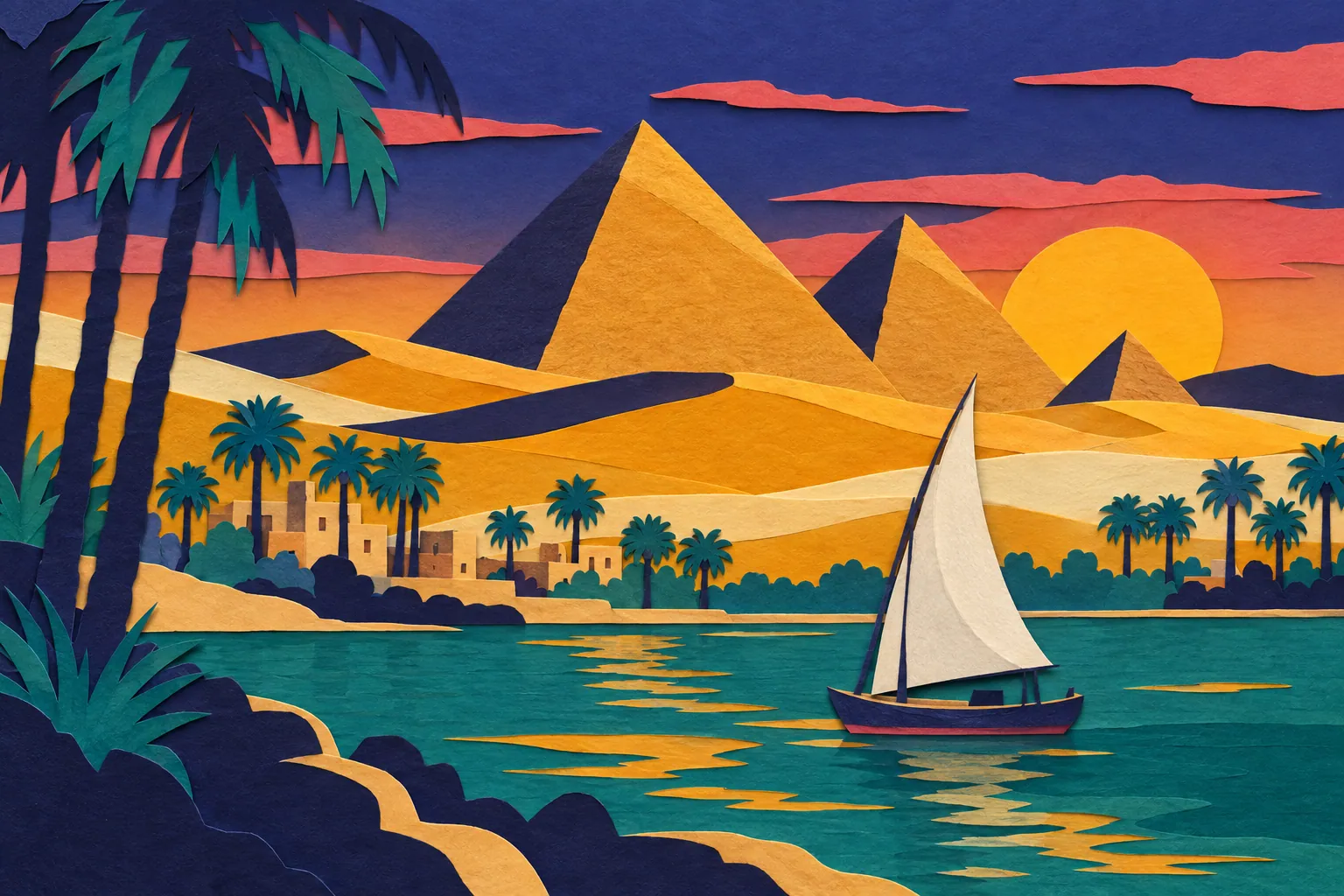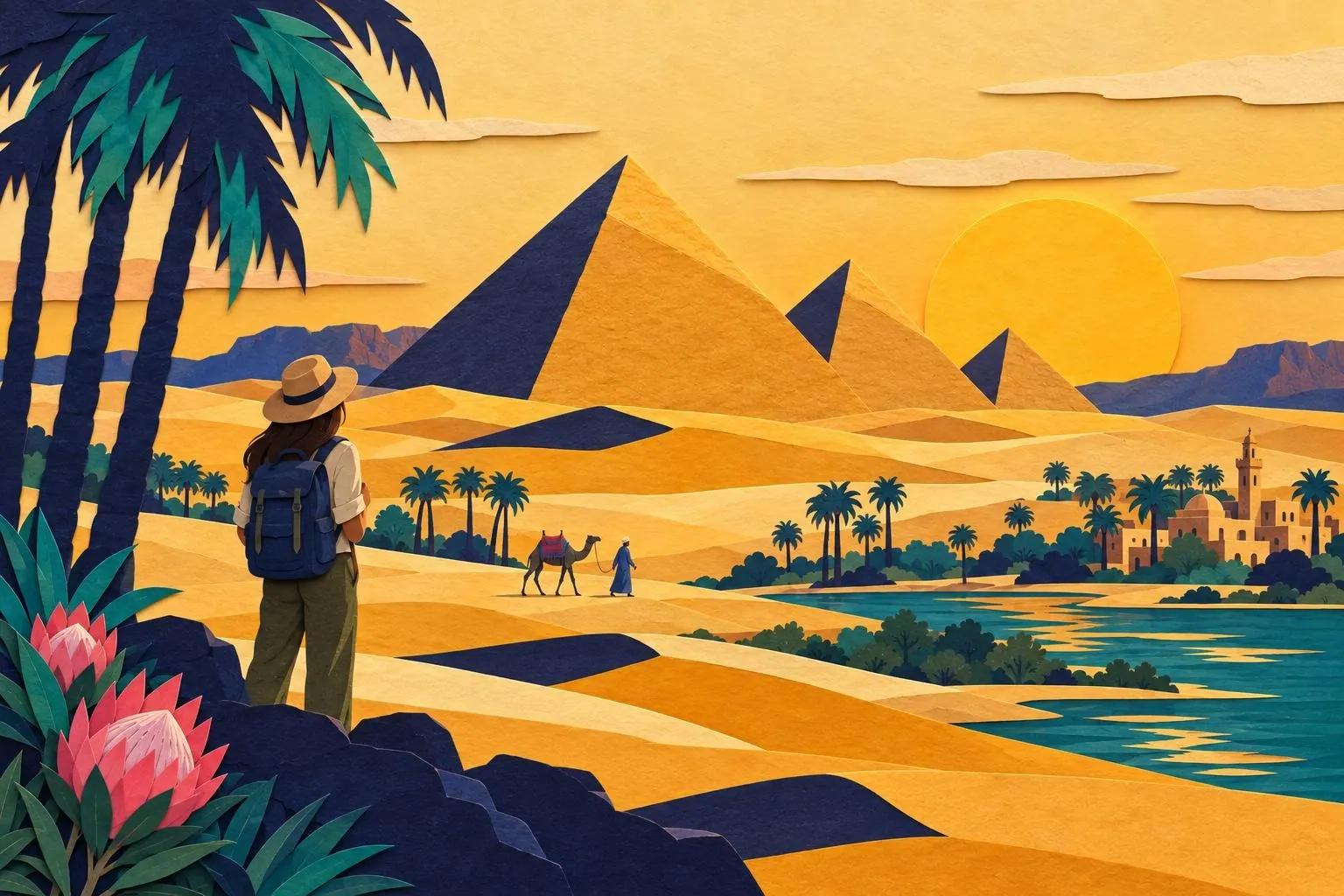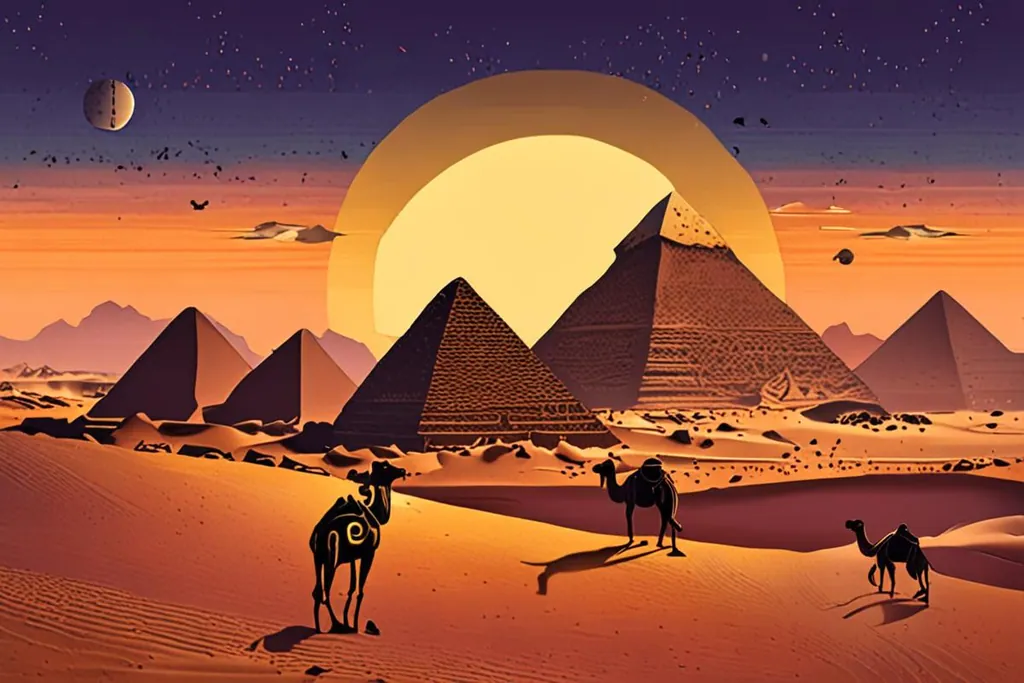
The pyramids of Giza are not three objects standing in sand. They are a necropolis on the edge of the Western Desert, thirteen kilometres south west of downtown Cairo and nine from the Nile, holding three royal pyramids, the smaller pyramids of their queens, temples, causeways, four cemeteries, the remains of the town where the builders lived, and the Sphinx lying on its east side looking out at the desert. The whole thing was raised during the Fourth Dynasty of the Old Kingdom, between about 2600 and 2500 BC, and the site takes a half day at least, because the distances inside it are real distances.
- Nhân sư, từ móng tới đuôi
- 73 m
- Nhân sư, từ chân đến đầu
- 20 m
- Lượng đá vôi ở Đại kim tự tháp
- 5.5 m t
- Số năm từ khi cao nguyên được xây
- 4,500
A necropolis, not three objects
The plateau is a working archaeological site arranged along a ridge. The Great Pyramid stands at the northern end, the pyramid of Khafre a few hundred metres to the south west, and the pyramid of Menkaure a few hundred metres beyond that. The Sphinx sits east of them, lower down and closer to the valley, and the ground between the monuments is filled with the mastaba tombs of officials and family members, laid out along streets and avenues as the pyramids went up.
The Sphinx was not carved from a block and dragged into place. It was cut out of the bedrock of the plateau itself, and the limestone taken from around its body was used to build the temple in front of it. That is the reason the monument is sunk into its own enclosure rather than standing on the ground: the quarry and the statue are the same operation.
The three pyramids
Khufu’s is the largest and the oldest, and it still has a few of its original casing stones at the base. The casing was fine white limestone from Tura, across the river, brought in by barge, and most of it was carried off during the Middle Ages to build the city of Cairo, which is why the pyramid presents its stepped inner blocks to the world instead of the smooth slope it was designed as. The complex around it included three smaller pyramids for queens and three boat pits, one of which held the Khufu ship.
Khafre’s pyramid is the one people mistake for the Great Pyramid. It sits higher on the ridge and its angle is steeper, so it appears larger while being smaller in both height and volume, and it keeps a prominent band of casing stones at its apex, which is what makes it look intact from a distance. Its complex included a valley temple that produced several statues of Khafre, the Sphinx temple, a causeway and a mortuary temple.
Menkaure’s is the smallest of the three and the only one of the four major monuments on the plateau with no original polished casing left at all. It was completed around 2510 BC and carries three subsidiary pyramids of its own. Of the three, it is the one that shows you plainly what a pyramid is underneath the dressing.
Cao nguyên được xây dựng như thế nào
Khoảng năm 2580 TCN
Khufu và Đại kim tự tháp
Lớn nhất trong ba kim tự tháp, xây cho Khufu, người Hy Lạp gọi là Cheops. Vỏ kim tự tháp làm từ đá vôi trắng ở Tura, bên kia sông, phần lớn bị lấy đi trong thời Trung cổ để xây Cairo, do đó hiện chỉ còn một ít ở chân đế.
Khoảng năm 2558 TCN
Khafre và Nhân sư
Con trai Khufu xây kim tự tháp thứ hai và toàn bộ quần thể xung quanh. Nhiều nhà Ai Cập học đồng thuận rằng đầu Nhân sư là của ông. Kim tự tháp này nằm cao hơn, có góc dốc lớn hơn nên nhìn to hơn Đại kim tự tháp dù thực tế lại nhỏ hơn cả về chiều cao và thể tích.
Khoảng năm 2510 TCN
Menkaure hoàn tất bộ ba
Kim tự tháp hoàng gia nhỏ nhất, kèm ba kim tự tháp nhỏ hơn. Đây là công trình duy nhất trong bốn di tích lớn của cao nguyên hiện không còn lớp phủ bóng nào.
2520 đến 2472 TCN
Nơi ở của công nhân
Khu định cư của công nhân phía đông nam hai quần thể Khafre và Menkaure, được Mark Lehner khai quật. Có lò bánh, xưởng bia, bếp ăn, xưởng đồng, bệnh viện, nghĩa trang, và khẩu phần gồm bánh mì, thịt bò và cá.
1979
Di sản thế giới
UNESCO đã công nhận Memphis và nghĩa địa, các khu kim tự tháp từ Giza đến Dahshur. Nhờ đó, cao nguyên Giza được xếp cùng Saqqara, Abusir và Dahshur, không bị coi là điểm đơn lẻ.
The Sphinx
The Sphinx is 73 metres long from paw to tail, 20 metres high from the base to the top of the head, and 19 metres wide at its rear haunches, which makes it the largest monolithic statue in the country and smaller than almost everyone expects. It faces east, towards the rising sun, in keeping with the solar cult of the Old Kingdom.
It has spent most of its history under sand. It was buried to the shoulders by the First Intermediate Period, and the first documented attempt to clear it dates to about 1400 BC, when the future Thutmose IV dug out the front paws and put a granite slab between them recording a dream in which the god promised him the throne in exchange for the work. That slab, the Dream Stele, is still there. The site was cleared again in Roman times, under Nero, and finally in 1926.
The nose was removed deliberately, with rods or chisels, and the story that Napoleon’s artillery did it is wrong: the damage is documented from at least the tenth century, and a fifteenth century account blames a Sufi who objected to the offerings being made at the statue. Fragments of its ceremonial beard are in the British Museum, and traces of red pigment on the face suggest the whole thing was once painted. What nobody has settled is whose face it is. The consensus is Khafre, but there is no contemporary inscription that says so, and the arguments for Khufu and for Djedefre have never been closed.
Who actually built it
The answer has changed in the last thirty years, and the evidence is on the site. Mark Lehner’s team excavated the workers’ town south east of the Khafre and Menkaure complexes and found communal sleeping quarters, bakeries, breweries and kitchens where bread, beef and fish were the staples, a copper workshop, a hospital, and a cemetery. The burials contain men who had survived injuries consistent with building accidents, and the tombs sit close enough to the monuments, with beer and bread left for the afterlife, to make the argument that these were workers who took pride in the work.
The numbers are still argued over. Herodotus was told the Great Pyramid took 100,000 men in three-month shifts over twenty years. Modern historians work from the tombs and the town and put the project at somewhere between twenty and twenty seven years with twenty thousand to thirty thousand year-round workers, and the burial evidence points to something like ten thousand labourers at a time. None of that supports the slave-labour story that the nineteenth century made popular.
Bạn dành ngày tham quan làm gì?
Bạn có muốn xem Bảo tàng Ai Cập Lớn trong cùng ngày không?
Bạn sẵn sàng rời Cairo trước bảy giờ sáng chứ?
Cả hai, bắt đầu bằng kim tự tháp
Hai địa điểm cách nhau hai ki-lô-mét, và bảo tàng cần một ngày riêng để khám phá. Tham quan cao nguyên trước, khi trời còn mát, khách đoàn chưa tới; xong thì sang bảo tàng ăn trưa và tham quan chiều. Đừng làm theo chiều ngược lại vì bảo tàng điều hòa mát còn cao nguyên không có.
Cao nguyên khi vừa mở cửa
Hai giờ đầu tiên là lúc nên tranh thủ. Ánh sáng từ phía đông chiếu lên các kim tự tháp, đoàn lạc đà chưa đón khách, bạn có thể đi bộ dọc cao nguyên trước khi trời nắng gắt. Hãy có mặt ở cổng khi mở cửa, đừng đợi đến lúc rời khách sạn.
Chuyến tham quan ngắn, hiệu quả
Nếu bạn chỉ có ba giờ, hãy đứng ở điểm toàn cảnh nhìn được cả ba kim tự tháp, sau đó đi bộ tới Nhân sư thay vì di chuyển bằng xe. Đó là góc chụp ảnh ai cũng thích, và đi bộ là cách cảm nhận quy mô thực tế của khu di tích.
Getting there, and getting in
The plateau is west of the river in the city of Giza, about nine kilometres from the Nile and thirteen from downtown Cairo, so the practical answer is a taxi or a ride-hailing car from the city, arranged before you leave. The metro reaches Giza and stops, leaving a taxi for the last stretch, and coaches bring guided groups in through the morning.
Buy your ticket from the state’s own portal, egymonuments, or at the gate, and treat anyone who approaches you offering one as a seller rather than a service. The same applies to camels, horses and carriages: the price is negotiable, and it should be settled in front of witnesses before you get on rather than after you get off. The plateau was given a €17 million renovation completed around 2021, which added a visitors’ centre, an electric bus, toilets, signage, a restaurant called the 9 Pyramids Lounge and free wifi, so the site is far better organised than its reputation suggests. The Osiris Shaft, a deep burial shaft with three levels, was opened to visitors in 2017.
Trước khi khởi hành
0/8
The rest of the necropolis
Giza is the northernmost part of a World Heritage Site that runs south through Abusir, Saqqara and Dahshur, and that is the reason to give the pyramids more than a photograph. Saqqara holds the step pyramid and the earliest stone architecture in the world, Dahshur has the two pyramids that show the transition to the smooth-sided form, and Memphis, the Old Kingdom capital that all of these pyramids served, lies between them. A day that takes in Saqqara and Dahshur after an early start at Giza reads the whole sequence in order.
The Grand Egyptian Museum, opened in full on 1 November 2025, stands two kilometres from the plateau with more than 100,000 objects and all 5,398 pieces from the tomb of Tutankhamun in two halls of their own. It is the natural second half of a pyramid day, and it is the one place in Egypt where being indoors in the afternoon is an advantage.