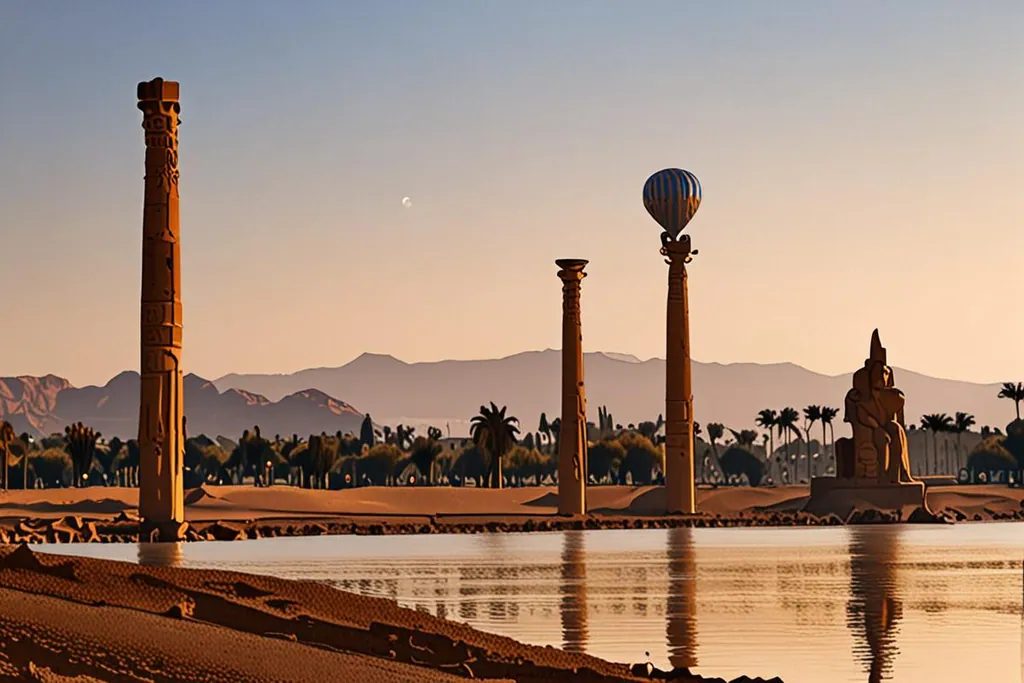
Luxor is the ancient city of Thebes, and it is not a museum with a town attached: it is a working town of about 285,000 people with the monuments of a former capital standing inside it. Karnak and Luxor Temple sit among the streets of the east bank. Across the river, the desert hills hold the tombs of the kings and the queens, the mortuary temples and the workers’ village that built them. Almost everyone crosses the Nile within an hour of arriving, because the visit divides in two and neither half is optional.
Two things shape the trip more than anything else. The first is heat: from May to September the days go past 40 degrees, so the sightseeing splits into a dawn half and an evening half. The second is the river, because the two banks are close enough to see each other and far enough apart that getting across is a decision you make several times a day.
- Residents of the city, 2023
- 284,952
- South of Cairo
- 670 km
- Average high in July
- 41.4 °C
- Of worship inside Luxor Temple
- 3,400 years
Thebes, the city of a hundred gates
The Egyptian name was Waset, which the Greeks rendered as Thebai, and the city was the capital of Upper Egypt and the religious centre of the country through the New Kingdom. It was the city of Amun, who became Amun-Ra as Thebes grew and whose temple at Karnak was the most important in Egypt until the end of antiquity. Karnak itself carries the older name ipt-swt, from which the Greeks made Thebes.
The city had its own gods, its own festivals and an annual procession that carried the statue of Amun down the river from Karnak to Luxor Temple, which is why the two temples are joined by a straight avenue of sphinxes 2.7 kilometres long. Luxor Temple was built around 1400 BC, in Egyptian ipet resyt, the southern sanctuary, and it was dedicated not to a god but to the renewal of kingship. Amenhotep III built the core of it, Tutankhamun and Ramesses II added to it, and Alexander the Great is said to have been crowned there. Two obelisks flanked the entrance; the western one has stood in Paris since the nineteenth century.
What the centuries did afterwards is the reason Luxor feels unlike the other sites. The temple was buried under a hill of rubble and houses, with a mosque built on top of its columns, and it was only excavated from 1884 onwards. That mosque, Abu Haggag, is still in use and still standing on the ancient columns, which makes it more than 3,400 years of continuous worship in the same place. The whole area, Ancient Thebes with its Necropolis, has been a UNESCO World Heritage Site since 1979.
When to go
Luxor is one of the driest and sunniest cities in the world, and it holds the Egyptian record for day to night range: about 16 degrees between the afternoon and the small hours, which is why a January evening needs a jacket after a warm afternoon. Rainfall is around 8 millimetres in a year and does not fall every year. Humidity sits near 40 per cent.
The useful split is not summer against winter but early against late. From October to April the average high runs from 22.8 degrees in January to 35 in April, and a whole day outdoors is comfortable. From May to September it climbs to 41.4 in July, the record is 50, and the only sensible pattern is gates at opening, a long middle of the day out of the sun, and the sites again in the last two hours of light. Winter nights fall to about 7 degrees in January.
The east bank
Karnak is the reason most people come and the part that is hardest to grasp in one visit. It is a walled complex of temples rather than a single building, built and rebuilt across two thousand years, and its hypostyle hall alone holds 134 columns in rows. Two or three hours is a fair allowance, and the late afternoon light in the hall is better than the middle of the day.
Luxor Temple is smaller, different in purpose and more beautiful at night. It stands in the middle of the city, a few minutes from the railway station and the corniche, and its pylon, its colonnade and the colossal seated figures of Ramesses II are lit after dark. The avenue of sphinxes that once ran the whole way to Karnak has been dug out of the silt and the houses that covered it, and the walk between the two temples is now a real one.
The west bank
The west bank is a necropolis and a landscape rather than a set of buildings. The Valley of the Kings holds the royal tombs, the Valley of the Queens holds the tombs of queens and princes, and the villages and terraces around them hold Deir el-Medina, where the tomb workers lived, the Tombs of the Nobles, Medinet Habu and the Ramesseum. Deir el-Bahari, the terraced temple of Hatshepsut, sits in the cliffs above the fields, and the two Colossi of Memnon stand in the flat ground on the road in.
It is also a site still being written. In February 2025 a joint Egyptian and British team identified the tomb of Thutmose II at a site west of the Valley of the Kings, the first royal tomb found since Tutankhamun’s in 1922, and in 2021 archaeologists announced a 3,400 year old city near Luxor, the largest ancient Egyptian settlement unearthed so far.
The practical rule for the west bank is to start when the gates open. The tombs are cut into rock and the exposed ground between them is hot by ten in the morning, so the first hour is worth two in the middle of the day. Tickets are bought at the sites themselves rather than in town, and a camera often needs a separate ticket.
Getting there, and getting across
Luxor International Airport takes a mix of domestic flights from Cairo and charter traffic from Europe, and the transfer into town is short by Egyptian standards. By rail, the station is 400 metres from Luxor Temple, on a line that runs north to Cairo and south to Aswan with several trains a day, including a morning service and a sleeper; the Cairo train is the standard way people arrive who are not flying. Cruise ships moor along the corniche, which is where the river traffic of the town comes from.
Crossing the Nile is the daily decision. The local ferry, sometimes called the National Ferry, leaves from a landing opposite Luxor Temple and is the cheap crossing. Motorboats make the same trip all day, at a price, on your schedule. A bridge opened in 1998 a few kilometres upstream carries the traffic, and that is the route taxis, hotel cars and the balloon minibuses use. On the east bank the calèches, taxis and short walks cover almost everything a visitor needs.
The shape of a day here
Before dawn
Balloons over the west bank
The flights lift off in the half hour before sunrise, when the air is still and the light is coming across the desert. You are over the fields, the tombs and the river at once, and back on the ground for breakfast.
Early morning
The west bank, while it is cool
The Valley of the Kings opens in the morning and heats up fast. Go there first, take Deir el-Bahari and the Colossi of Memnon on the way back, and be finished with the exposed sites before the middle of the day.
Midday
Shade, water and a long lunch
This is the part of the day the tombs and the open courtyards do not want you. Eat, sleep, or sit in a garden, and treat the middle hours as the gap between two working halves of the day rather than as lost time.
Afternoon
Karnak
The largest temple complex in the country takes two or three hours, and the light on the hypostyle hall improves towards the end of the day. It is a walk or a short ride from the centre of town.
Evening
Luxor Temple, lit
Luxor Temple sits in the middle of the city, and after dark the columns and the pylon are lit. It is the one site in Luxor that is better in the evening than in the morning.
Staying online
Luxor is the place where a phone stops being a convenience and starts being part of the itinerary. Ticket pages, the ferry timetable, the ride you booked from the west bank after sunset and the restaurant you are walking towards all assume a connection, and the west bank in particular is where the difference shows.
The choice is the same as anywhere in Egypt. A local SIM needs a passport and a counter, usually in the city rather than at the river. Roaming, if your operator’s pass is reasonable, works and costs more. A travel eSIM installed before you fly is the least trouble of the three, and it means the first thing you do in Luxor is look at the river rather than at a shop.
How will you get online?
Do you need calls and texts on your own number while you are in Egypt?
Is your operator’s roaming pass cheaper than about five dollars a day?
A travel eSIM for data
Install it at home and move data to the eSIM line on landing. The ferry timetable, the tomb ticket bought online and the ride back from the west bank after dark all want a connection, and the west bank is the place where you notice having one.
Your own line, roaming on
If the pass is cheap and the trip is short, this is one less thing to arrange. Turn data roaming off for everything you do not need, because a phone syncing photographs over a guesthouse connection will find the mobile allowance instead.
Where to sleep, and what to eat
The east bank is the practical base: hotels of every standard, the restaurants, both temples within walking distance and the station at the end of the road. The corniche and the streets behind it are where the town lives in the evening. The west bank is the other answer, and for the right traveller it is the better one: guesthouses with gardens, a view of the temples across the water, and a head start of twenty minutes on everyone staying in the city when the gates open.
Food is Upper Egyptian and straightforward: grilled meat and pigeon, rice and vegetables, bread from a clay oven, and hibiscus tea hot or cold. Alcohol is available in hotels and a few licensed restaurants rather than generally.
Days out
The Nile itself is the day out from Luxor. Cruise boats run between Luxor and Aswan, stopping at Edfu and Kom Ombo on the way, and the train does the same route in a few hours with a first class carriage that is cheap by European standards. Aswan is 220 kilometres south, with the Nile at its widest, Nubian villages and the temples at Abu Simbel beyond it. North, the line to Cairo passes through Qena, which is the junction for the temples at Dendera.
One caution from the Foreign, Commonwealth and Development Office: check what your travel insurance covers before you travel, and remember that balloon flights are the kind of activity a standard policy may leave out.
Before the first tomb
0/8
Luxor rewards a slower visit than its reputation suggests. Two mornings on the west bank, one afternoon in the temples, one evening at Luxor Temple, and a long lunch in the middle of a hot day will give you more than a rushed list of monuments ever does.