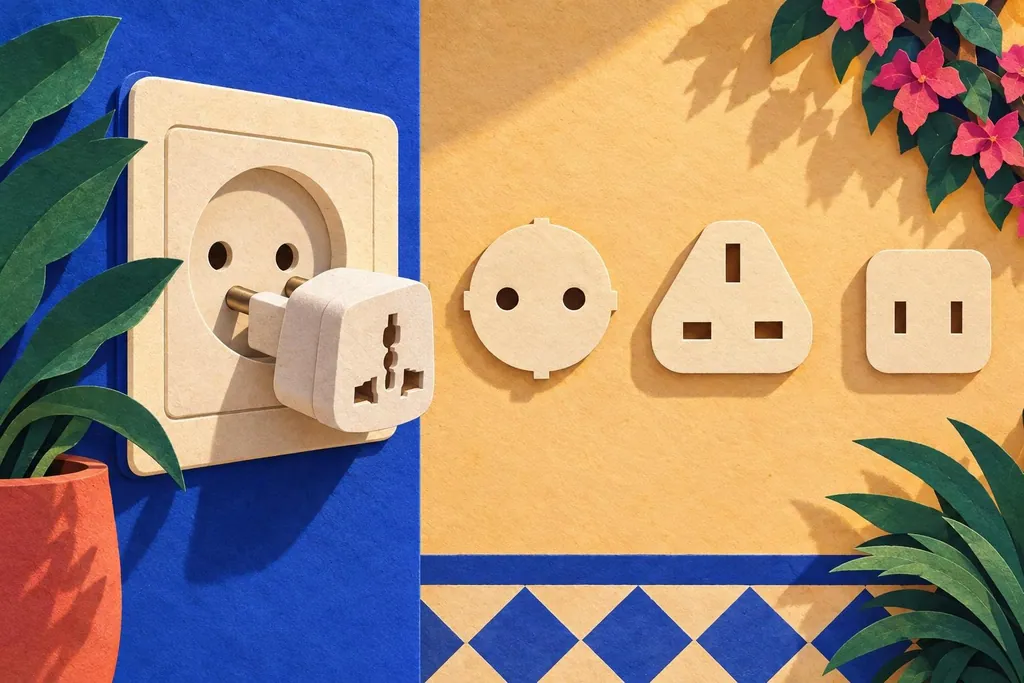
Morocco’s wall sockets take plugs with two round pins, as in France, Belgium and Poland. Most travellers from continental Europe can plug in as they are. British, Irish, American, Canadian and Australian plugs need an adapter, and an appliance built only for 120 volts needs a converter as well.
- Socket types, in the IEC list and on WorldStandards
- C and E
- Frequency, in both
- 50 Hz
- Voltage in the IEC list, which also gives 127 V
- 220 V
- Voltage on WorldStandards
- 230 V
Which sockets Morocco uses
The IEC and WorldStandards both list two socket types for Morocco: C and E.
- Type C is the socket for the Europlug, a thin plug with two round pins. The IEC describes it as a two-wire plug that fits any socket taking round pins of 4.0 to 4.8 mm on 19 mm centres, used across Europe except the UK, Ireland, Cyprus and Malta, and generally limited to appliances drawing 2.5 amps or less.
- Type E takes two 4.8 mm round pins spaced 19 mm apart and has a round earth pin that sticks out of the socket. The plug has a hole for that pin. The IEC lists type E for France, Belgium, Slovakia and Tunisia among others, and rates type E plugs at 16 amps.
What goes into which socket matters more than the letters. WorldStandards lists the type E socket as compatible with type C, E and F plugs, and the type C socket with type C plugs only. The German-style type F plug has earth clips on its sides instead of a hole. The IEC notes that the hybrid plug known as CEE 7/7 has both the clips and the hole, so that it works in type E and type F sockets, and WorldStandards says type F plugs can be used with type E sockets.
Morocco’s voltage: 127, 220 or 230 volts?
The references do not give the same figure, so here is what each one states:
| Reference | Voltage | Frequency | Sockets |
|---|---|---|---|
| IEC World Plugs list, archived on 19 January 2026 | 127 V and 220 V | 50 Hz | C and E |
| WorldStandards, updated 12 July 2025 | 230 V | 50 Hz | C and E |
| Lonely Planet, 11 March 2025 | 220 V | 50 Hz | C and E |
The IEC has since withdrawn its World Plugs guide. Its page now says the interactive guide is no longer available, so the January 2026 copy is the last archived version of its list.
For packing, the gap between 220 and 230 volts changes nothing. Apple, for example, designs its USB power adapters for power sources of 100 to 240 volts at 50 or 60 Hz, a range that covers all three figures. The gap that matters is with the 120 volts that the IEC lists for homes in the United States and Canada. Electrical Safety First says that where the supply voltage is different, you need a voltage transformer or converter, unless the appliance or its power supply is dual voltage rated. The frequency differs too, 60 Hz there against 50 Hz here, and the same advice gives the example of a 50 Hz clock running faster on a 60 Hz supply.
Will your plugs fit?
Choose the country your plugs come from. The answer uses each country’s plug types and voltage from the IEC’s list.
Will your plugs fit in Morocco?
Your round two-pin plugs (types C, E and F) go into Moroccan type E sockets. A type C socket takes only the thin type C plug, and three-pin plugs such as the Swiss J or the Italian L need an adapter.
France, Germany, Spain, Portugal, Italy, Netherlands, Belgium, Switzerland, Poland, Sweden, Algeria, Tunisia
You need a travel adapter: Moroccan sockets are types C and E, for plugs with two round pins.
United Kingdom, Ireland, United States, Canada, Australia
Homes in the US and Canada run on 120 volts. Chargers marked 100 to 240 V work in Morocco; anything marked 110 to 120 V only needs a voltage converter.
In short, round two-pin plugs from France, Belgium, Poland, Germany, Spain, Portugal, the Netherlands and Sweden go into a type E socket, and so do plugs from Algeria and Tunisia. Italy and Switzerland also use type C plugs, but their own three-pin plugs (types L and J) do not fit. British and Irish plugs (type G), American and Canadian plugs (types A and B) and Australian plugs (type I) all need an adapter.
Adapters, converters and dual-voltage chargers
A travel adapter only changes the shape of the pins. It does not change the voltage. A dual-voltage appliance says so on its label: Electrical Safety First gives the example of a marking such as “INPUT: 110-240V” on the appliance or its power supply. If yours shows a range like that, the adapter is all you need.
The same advice has three more points worth following:
- Before plugging an appliance into an adapter, check that it does not exceed the adapter’s maximum rating, shown in amps or watts.
- Some adapters are not suitable for appliances that need an earth connection and should only be used with double-insulated equipment.
- Buy adapters and converters before you go, from a reputable retailer rather than a third-party seller online. In the UK, travel adapters must meet the safety standard BS 8546.
If you do forget, Lonely Planet notes that adapters are readily available in Morocco, as well as in the US and Europe.
Power banks on the flight
A power bank keeps a phone going through long days of maps and photos, and the rules for flying with one changed in 2026. From 27 March 2026, the UK Civil Aviation Authority lists these rules for passengers:
- a maximum of two power banks per person, carried in cabin baggage;
- each one individually protected when not in use;
- not recharged on board, and not used to charge other devices on board;
- up to 100 Wh without approval, and more than 100 Wh up to 160 Wh only with the airline’s approval.
Check your airline’s own page before you fly as well.
Charging in riads and desert camps
In an older riad or guesthouse, look at the sockets when you arrive. A type C socket takes only the thin type C plug, so a German or Spanish plug with a thicker round body may need an adapter even in Morocco. If several of you share one socket, a charger with several USB ports saves a queue.
The desert is where the grid ends. Lonely Planet describes the camps at Erg Chigaga as off the grid, several hours’ camel trek from the nearest street lights, and says that in desert camps Wi-Fi may be available, but often only in public areas, with connections that can be spotty. Camps differ: at least one camp near Merzouga says on its own site that guests can charge phones and small devices during their stay. Ask yours when you book, charge your phone and power bank in town before you set out, and download offline maps first, as Lonely Planet advises before heading into the desert.
Charging kit for Morocco
0/10
Staying online in Morocco
A charged phone is half the job; the other half is a connection. Our Morocco eSIM plans run on Orange Maroc’s own network, so your phone connects as a Moroccan line, not as a roaming visitor. Install the eSIM at home on Wi-Fi, keep the line off, and switch it on when you land. Every plan is data only, so your usual SIM stays in the phone for calls and texts.
Travelling on? The guides to plug types in Egypt and South Africa’s plugs and sockets cover the sockets there, and our Morocco travel tips cover the rest of the trip.