South Africa is the rare country whose plug standard is genuinely its own. The large three round pin plug, type M, is used almost nowhere else in the world, which is why a universal adapter that has served you in twenty countries can still fail here. The pins are bigger than anything else in common use.
There is a transition under way, and understanding it takes the mystery out of the two sockets you will see side by side on the same wall.
- Mains voltage
- 230 V
- Frequency
- 50 Hz
- Current of the type M plug
- 16 A
Two sockets, one country
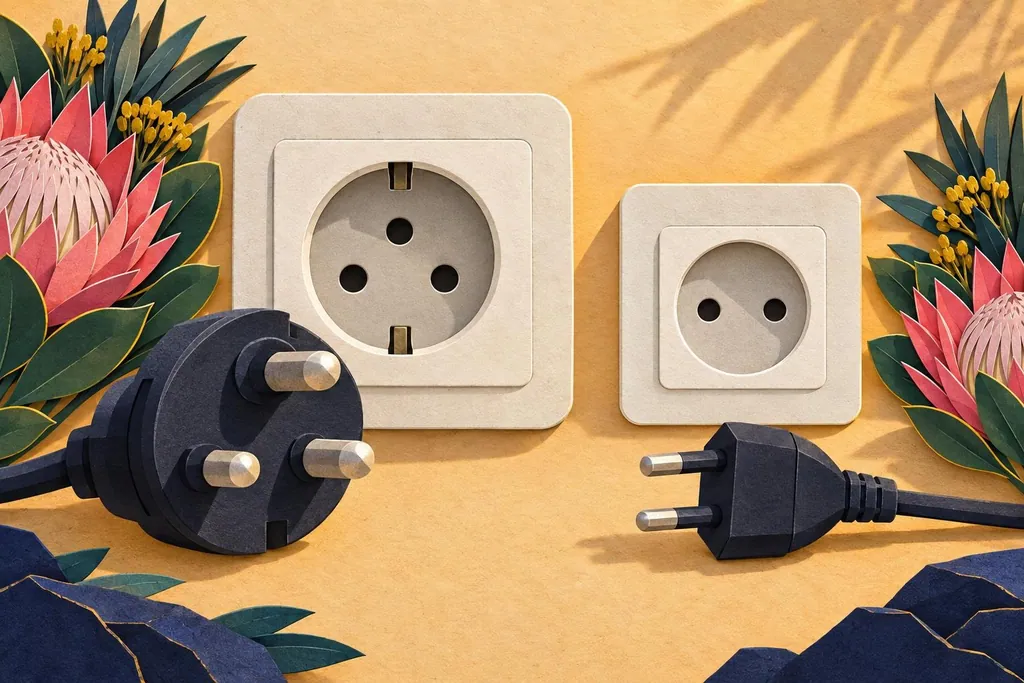
Type M is the old standard and still the one in most buildings. It has three round pins forming a triangle, the earth pin offset at the bottom, and it carries 16 amps. If you have seen a South African plug, that is the one you have seen.
In 2013 the country adopted type N, a smaller and neater design, as the preferred standard. The rule that followed is the reason for the pairs of sockets: since 2018 every wall outlet in a new home must include at least one type N socket, and a type M socket may only be installed beside one.
So a newer hotel room may have both, an older guesthouse will have type M only, and a farm stay built forty years ago may have a type M socket that is loose enough to need a firm push. None of that is a fault. It is what happens when a country changes a standard slowly, on purpose, over decades.
Will your plugs fit?
Almost certainly not, and it is worth accepting that before you pack rather than discovering it in a lodge in the Drakensberg.
Will your plugs fit in South Africa?
You need a travel adapter for these large three round pin sockets.
United Kingdom, Ireland, Germany, France, Netherlands, Spain, Italy, Sweden, Poland, Switzerland, United States, Canada, Australia, New Zealand
Home runs on 120 volts and South Africa on 230. Chargers marked 100 to 240 V are fine, anything else needs a converter.
The short version: everyone needs an adapter. British and Irish plugs do not fit. European round two-pin plugs do not fit. The German type F plug with side clips does not fit. American, Canadian, Australian and New Zealand plugs do not fit.
There is one nuance worth knowing, because it catches people out. The newer type N socket is designed to accept a plain European type C plug, the simple two-pin one found on most phone chargers. If your charger has that plug, it will go into a type N socket without help. If it has the type F plug with clips, it will not. Since you cannot tell in advance which socket your room will have, the adapter is still the thing to bring.
The voltage
South Africa supplies 230 volts at 50 Hz, which is the European figure rather than the North American one. Visitors from Britain, Europe and Australia have nothing to think about beyond the pin shape.
Visitors from the United States and Canada have one thing to check. Anything marked 100 to 240 V is fine, and that covers phone chargers, laptop bricks, camera chargers and power banks. A hair dryer, straightener or travel kettle built for 120 volts is not fine, and needs a converter or should stay at home.
Power cuts, and why the adapter is not the problem
South Africa has a well known history of scheduled power cuts, and while the worst of them has passed, outages still happen. When the power goes, the lights go, the wifi goes and your charger stops, and it is easy to blame the adapter or the socket.
It is not the adapter. It is the grid.
The practical answer is a power bank and a habit of charging when the power is on rather than when you need it. Most hotels and lodges have a backup generator or an inverter that keeps some circuits alive, usually the lights and sometimes the wifi, and reception will tell you which. Load shedding and what it means for a trip goes through the detail, including how to check the schedule before you book anything that depends on power.
What socket your room will have
The standard depends on the age of the building, and knowing what to expect makes packing easier.
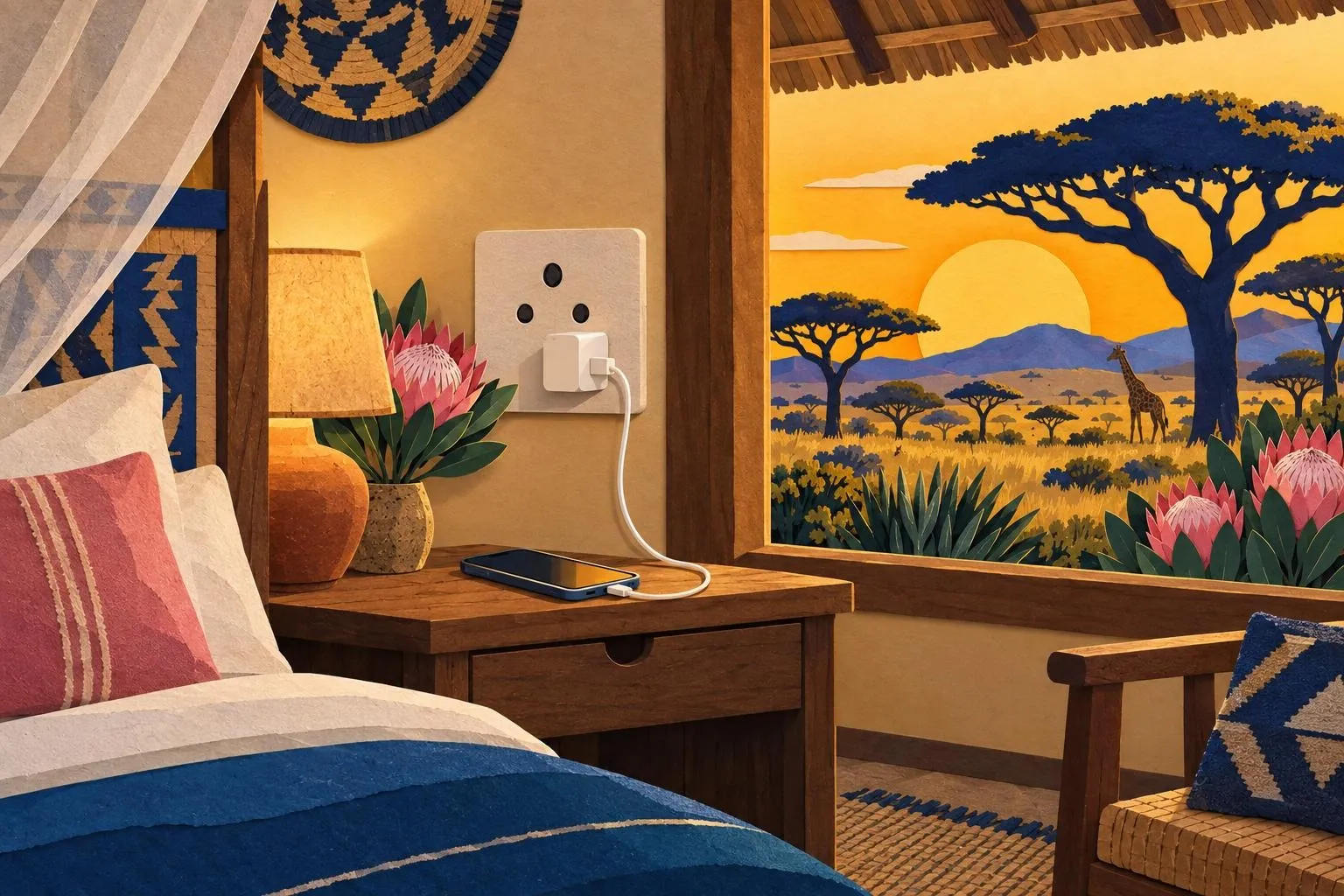
A hotel built in the last decade will almost certainly have type N sockets, often a pair of them at the desk. A guesthouse in a converted older house will have type M, usually two or three per room and frequently in awkward places behind a wardrobe. A safari lodge in a rural area is the least predictable: some run on solar and inverter systems with their own sockets and their own rules, and a few keep power points out of the rooms deliberately.
Farm stays and backpacker hostels are the wildcard. An old farmhouse can have a mixture of M, N and the round three-pin British sockets in the wing that nobody got round to rewiring.
The consequence is the same everywhere. Bring one adapter, bring the plug that belongs to your charger rather than the cable alone, and do not assume the room has the socket your adapter was designed for.
What to pack
Charging kit for South Africa
0/7
One last thing about adapters, and it is a genuine warning. Buy a South African adapter, not a universal block with a slider. Universal blocks are built around the smaller pins used elsewhere, and the type M pins are thick enough that a universal block will either not hold them or will hold them badly enough to arc. A dedicated adapter costs very little and does not fail.
If you are still sorting out the phone side of the trip, an eSIM for South Africa covers the data question, and the network picture here explains which networks reach where.