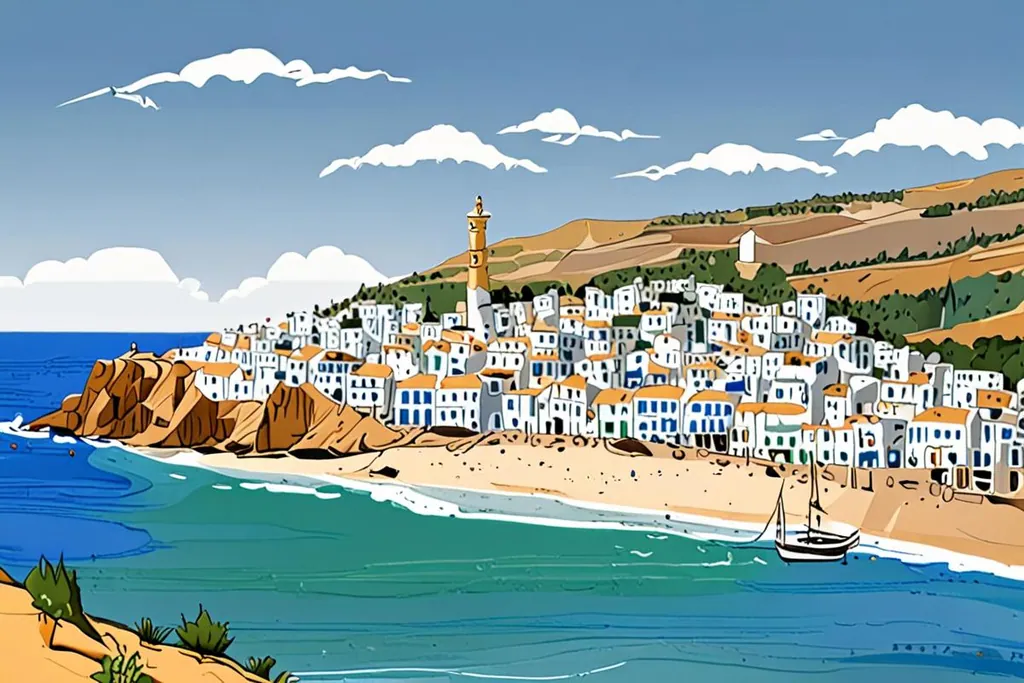
Taghazout is nineteen kilometres north of Agadir, on a coast that runs north east to south west with the High Atlas foothills behind it. It has 5,233 people, one long street, a mosque, fishing boats drawn up on the sand, and a hillside of white houses that has been filling with guesthouses since surfing found the place in the late 1960s.
It is worth being clear about what it is. This is not a resort town that happens to have waves: it is a fishing village that surfers moved into, and the flat months are still the fishing village, in the way that fishing villages are.
- Dân số làng, 2014
- 5,233
- Về phía bắc của Agadir
- 19 km
- Từ làng đến Anchor Point
- 3 km
- Nhiệt độ nước mùa lướt sóng
- 21 °C
How it became a surf town
The written history of the village is thin, and the oral history begins with the Portuguese. Berber tribes from the surrounding hills held this stretch of coast against them, and the village was a store for fishing gear rather than a place anyone lived. As Spanish influence grew along the coast in the 19th century, workshops and a mosque were built to house the families who had been camping in the foothills, and Taghazout became a village.
The part that made it famous is recent. In the late 1960s a beach just south of the village became a stop on the route young travellers took through southern Morocco, and in the good years several hundred of them lived there in tents, shacks and camper vans. That camp was banned, and equipped hotels and resorts took its place, but surfing stayed and became the village economy. In 1992 the village became the centre of its own municipality, which is also when water, power and telephone lines arrived.
Làng thành thị trấn lướt sóng như thế nào
Thế kỷ 16
Bộ lạc Berber chống lại người Bồ Đào Nha
Lịch sử truyền miệng của vùng này bắt đầu bằng các cuộc đụng độ giữa các bộ lạc Berber đoàn kết và người Bồ Đào Nha, khi họ kiểm soát các cảng dọc bờ biển này. Làng lúc bấy giờ chỉ là nơi cất đồ nghề đánh cá chứ chưa có người lập cư.
Thế kỷ 19
Xưởng chế biến và nhà thờ Hồi giáo
Khi ảnh hưởng Tây Ban Nha lớn dần trên bờ biển này, các xưởng sản xuất và nhà thờ Hồi giáo được xây để đón các gia đình Berber vốn sống quanh đồi, từ đó Taghazout thành làng thay vì chỉ là kho chứa.
Cuối thập niên 1960
Khu trại
Một bãi biển phía nam làng trở thành điểm dừng của dân phượt trẻ trên đường qua miền nam Maroc. Vào thời đỉnh điểm, có đến vài trăm người sống ở đó bằng lều, chòi tạm và xe camper.
Từ đó đến nay
Khách sạn thay thế lều trại
Khu trại bị cấm, các khách sạn và khu nghỉ dưỡng xuất hiện thay thế. Sóng và lướt sóng thì vẫn còn, và dần thành lý do chính để dừng chân tại đây.
1992
Tự làm đô thị riêng
Taghazout trở thành trung tâm của một đô thị độc lập bao gồm cả làng và các khu dân cư trên đồi, cũng là lúc hệ thống nước, điện, điện thoại được đưa tới.
The road from Agadir, and from the airport
The village is on the coastal road, nineteen kilometres north of Agadir and 152 kilometres south of Essaouira. The nearest airport is Agadir Al Massira, which sits at Temsia, twenty kilometres south east of Agadir, and carried 2.3 million passengers in 2023; the runway is 3,200 metres and the terminal is built for three million passengers a year, which tells you how seasonal this coast is.
So the transfer is a two part journey: from the airport into Agadir or around it, then north along the coast. Expect around an hour by car, more in the evening when Agadir does its impression of a car park. Buses and grands taxis run between the city and the villages along this road, and most guesthouses will send someone to meet you if you ask, which is worth doing with boards or bags.
The breaks, and the season
The reason people come is a row of right hand point breaks, and the one everybody knows is Anchor Point, three kilometres north of the village. In the right conditions a ride starts there, joins Hash Point and finishes on the beach break at Panorama’s, which adds up to something close to two kilometres of wave. The season runs from September to April, and the water is at its warmest in the same months, up to about 21 degrees.
Between the points there are friendlier waves. The bay inside the village is the place to learn, and the beaches north of Agadir, from Tamawanza at 12 kilometres out to Aghroud at 30, give you something to choose from on the days when the points are too big or too crowded. Board hire and lessons are part of the village economy now, so a week that starts with falling off ends with catching something.
Bạn đến đây để làm gì?
Bạn có muốn đứng lên ván lướt ngay trong tuần này không?
Bạn có hài lòng nếu đi vào mùa vắng khách không?
Một tuần học từ tháng 9 đến tháng 4
Hãy đến mùa sóng, khi sóng chạy và nước cũng ấm nhất, khoảng 21 độ. Ở gần bãi trong vịnh, nơi sóng nhỏ, và đăng ký 2-3 buổi học sẽ giúp bạn bắt đầu quen ván ngay từ ngày đầu tiên. Buổi sáng thường sóng sạch và yên tĩnh hơn chiều.
Những tháng lặng sóng, từ tháng 6 đến 8
Mùa hè ở làng đúng chất địa phương: nước ấm, sóng nhỏ, gia đình dạo chơi trên bãi và khách sạn chủ yếu đón khách Maroc. Thưởng thức bãi biển, đồi argan phía sau và các chuyến dạo trong ngày, còn ván lướt thì chỉ coi như để mang theo hơn là thực sự sử dụng.
Lên phía bắc đến Imsouane và Essaouira
Nếu bạn chỉ thích xem hoặc thấy làng quá nhỏ, bờ biển phía bắc sẽ nhiều lựa chọn hơn: bãi dài tại Imsouane, gió và thành cổ ở Essaouira, cách 152 ki-lô-mét về phía bắc. Đường đi đơn giản và nơi này cũng có cùng mùa sóng từ tháng 9 đến tháng 4.
Flat months, day trips and the hills behind
From June to August the swell goes quiet and the village changes character. The hotels fill with Moroccan families, the water is at its warmest, and the trade is beach rather than surf. It is a good time to be here with children, and a bad time to be here with a performance shortboard.
The hills behind are worth a day of anyone’s time. Paradise Valley, up the valley behind the coast, is the standard trip, the argan cooperatives along the road sell the oil and explain the trees, and the coast road north has one beach after another with a car park and a café. Paddle boarding inside the bay, kayaking, camel rides on the sand and yoga are all sold in the village, and Agadir is twenty minutes away if you want a city for an afternoon.
Working from the coast
A month here is a normal thing to do now, and it works with the right expectations. Taghazout is a village: the good connections are in the guesthouses and hotels that advertise them, and the way to check is to stand in the room you are being shown and test the connection yourself, because the hillside and the thick walls both matter. Agadir, down the road, has faster and steadier options, along with the co-working spaces and the shops.
Two other things help. Buy your data before you leave the city, either at the airport on arrival or in Agadir, because there is nowhere in the village to buy a plan at nine in the evening. And accept that the day runs on the swell forecast rather than on a calendar: the quietest working hours here are the flat ones in the middle of the day, when everyone else is asleep.
Những điều bạn nên kiểm tra trước khi ở lại một tháng
0/8