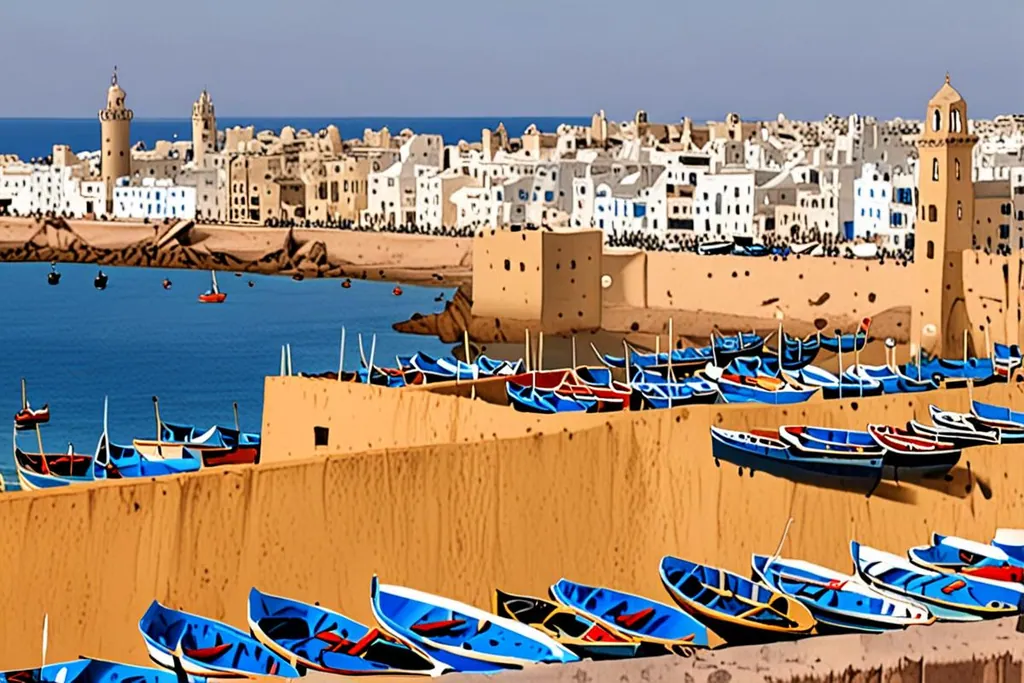
Essaouira sits on a bay that the Iles Purpuraires shelter from the swell, which is why people have used it as an anchorage for two and a half thousand years. Carthaginian traders called in during the fifth century BCE, and in the first century BCE King Juba the Second of Mauretania ran a dye works here, boiling murex shells collected from the rocks into the purple that coloured the stripe on a Roman senator’s toga.
Until the 1960s the town was known by its Portuguese name, Mogador, which probably comes from the Phoenician migdol, a small fortress. That is the whole history in one word: an anchorage, a fort, and then a city designed on paper in the eighteenth century by people who had read their military engineering.
- Dân cư, điều tra năm 2024
- 82,962
- Năm thành lập thị trấn
- 1769
- Lượng mưa trung bình năm
- 300 mm
- Giờ nắng mỗi năm
- 2,979
Why the wind runs the day
The alizés, the trade winds that work their way down the Moroccan Atlantic coast, reach Essaouira through the bay and arrive faster than they were. From late spring to early autumn they come in most afternoons, and they are strong enough that the town has built a whole economy on kitesurfing, windsurfing and sailing.
That rhythm shapes a visit. Mornings are calm and hazy, the light on the ramparts is at its cleanest, and the beach is quiet. Around midday the wind fills in, the kites go up off the northern end of the beach, and anyone without a harness goes looking for a wall to sit behind. The one thing worth knowing is that the wind hides the sun and the sea hides the cold: the Canary Current and the upwelling that makes the sardines so good also keep the water colder than the latitude suggests, and the Atlantic here is an ocean with a current in it rather than a swimming pool.
South of town the coast turns into surf country properly, with Sidi Kaouki about twenty minutes away along the beach road and Moulay Bouzerktoun beyond it, both with hire, schools and somewhere to eat. Buses and taxis run that way, and a windswept village with a cafe and a break in front of it is a reasonable plan for a day.
A town built in one go
Essaouira is unusual among Moroccan medinas in having a single author and a date. Sultan Mohammed III wanted an Atlantic port close to Marrakech and able to trade directly with Europe, so in 1760 he put a French engineer, Théodore Cornut, to work on a fortified town for foreign merchants, with Moroccan architects from Fes, Marrakesh and Rabat building alongside him, and a renegade Englishman who had converted to Islam, Ahmed el Inglizi, on the harbour gate. The plan was drawn up in the manner of Vauban, the French military engineer, and it was largely finished within a dozen years.
The economics made it work. The sultan closed Agadir’s harbour in 1767 so that trade from the south had to come here, and the caravan route that ran from Timbuktu over the Atlas to Marrakesh found the sea at the end of it. Essaouira became the country’s principal port and, for a period, its diplomatic capital, with consulates from half of Europe inside the walls. Jewish merchants were invited to settle and to run the trade with Europe, and they were at one point a majority of the population; the mellah, its synagogues and the Bayt Dakira heritage house are still there.
Sáu cột mốc làm nên Essaouira
1506
Pháo đài Bồ Đào Nha xuất hiện
Manuel Đệ Nhất của Bồ Đào Nha ra lệnh xây pháo đài tại Mogador như một mắt xích dọc bờ biển Maroc. Castelo Real trụ được bốn năm trước khi bị kháng chiến địa phương đánh chiếm lại năm 1510.
1760
Mohammed III xây dựng thành phố
Vua muốn có một cảng Đại Tây Dương gần Marrakech. Ông giao nhiệm vụ cho kỹ sư Pháp Théodore Cornut, người đã dành mười hai năm lên bản thiết kế dựa trên pháo đài kiểu Vauban, với các kiến trúc sư Maroc và châu Âu cùng tham gia.
1767
Agadir mất cảng biển
Hoạt động giao thương từ phía nam được chuyển sang cảng mới và Essaouira trở thành cảng thương mại chính của quốc gia, nơi các đoàn lữ hành từ Timbuktu đến với biển.
1844
Người Pháp nã pháo vào cảng
Ngày 16 tháng 8 năm 1844, hạm đội Pháp dưới quyền Hoàng tử de Joinville pháo kích và chiếm đóng tạm thời thị trấn, sau khi Maroc hỗ trợ Abd el-Kader ở Algeria. Các thành lũy vẫn tồn tại sau vụ này.
1864
Tàu chiến Mỹ bắn phá
Tàu CSS Georgia thiếu lương thực, cử thuyền vào bờ nhưng bị đẩy lui, sau đó bắn một phát đạn vào thị trấn. Đây là lần duy nhất pháo miền Nam Hoa Kỳ bắn ngoài Bắc Mỹ.
2001
UNESCO công nhận khu medina
Phố cổ được ghi danh là Medina Essaouira, từng là Mogador, dựa vào bản thiết kế quân sự châu Âu trong bối cảnh Bắc Phi và sự nguyên vẹn của bố cục thế kỷ XVIII.
The ramparts, the port and the medina
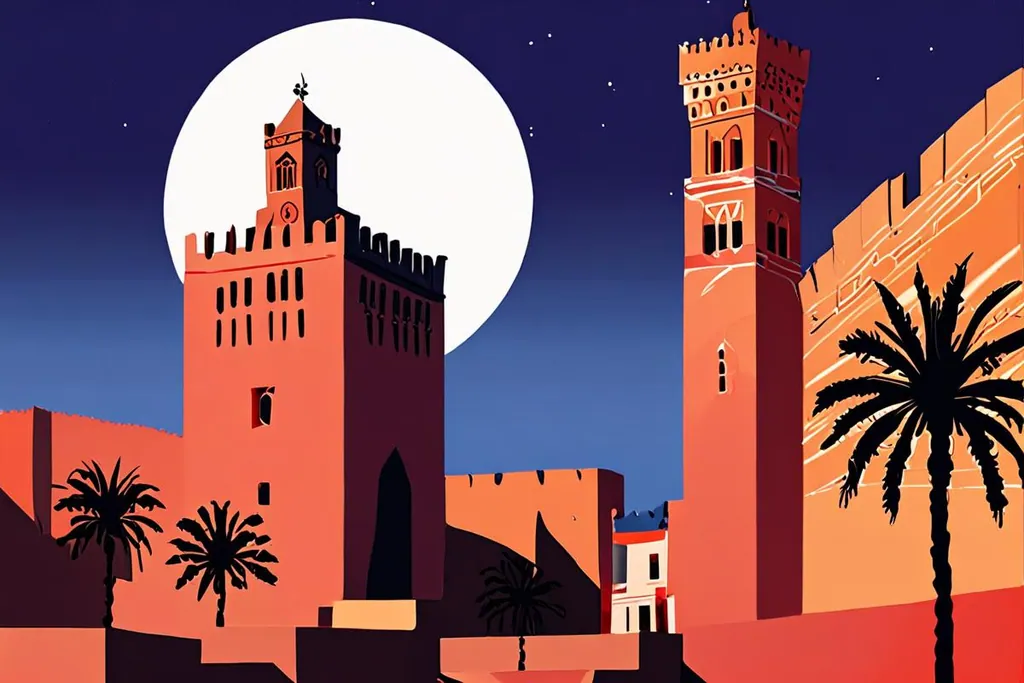
Walk the walls first, at the hour when the light is still low. The Sqala de la Kasbah is the long platform above the sea with a line of old bronze and iron cannon pointing at nothing in particular, some of them cast in Europe in the 1740s; the Sqala du Port faces the other way, over the fishing boats, and both are free to walk. Between them is the Porte de la Marine, the gate Ahmed el Inglizi built, and inland the clock tower at Bab Manjana, which now houses a collection of musical instruments after a career that included a spell as a prison.
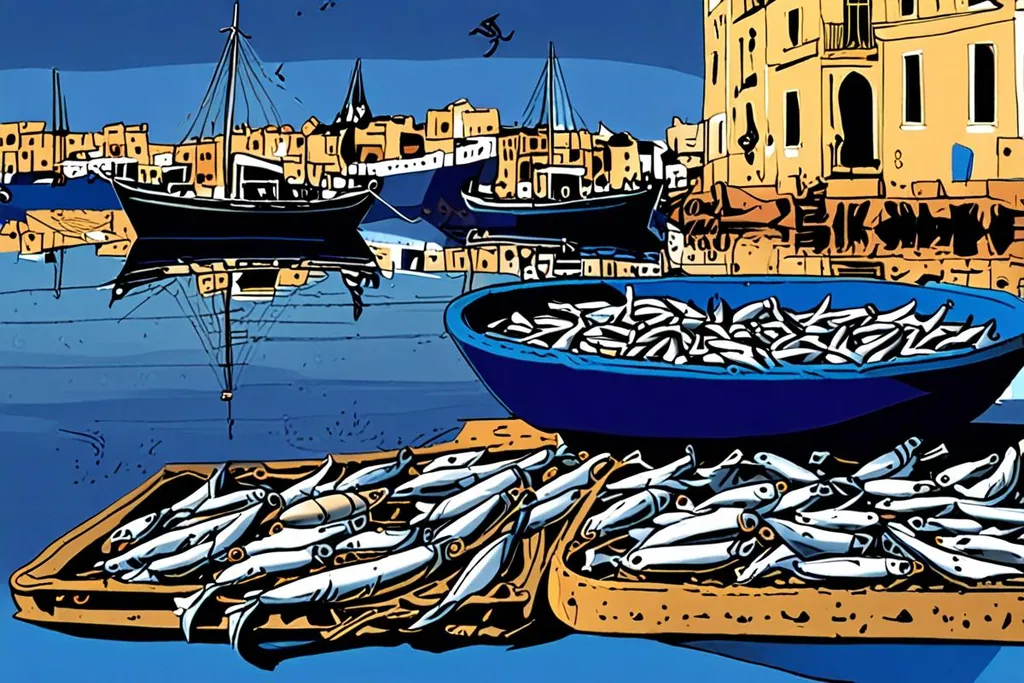
Below the walls the fishing port works every morning, and the sardines come off the boats and on to the grills under the arcade of stalls almost in the same breath. Inland of it, the medina is small, cheerful and hard to get lost in: a grid of lanes rather than a labyrinth, with the thuya wood workshops and marquetry shops that Essaouira is known for, the Mellah and its synagogues, the Ben Youssef mosque behind the clock tower, and the small museum named for Sidi Mohammed ben Abdallah holding what the excavations on Mogador island turned up.
Then there is the beach. A long curve of sand runs south from the port, backed by the dunes and the ruins of the Bordj el Berod, the fort that visitor lore credits to Jimi Hendrix on the strength of a stay in the village of Diabat in 1969 rather than anything he built there.
Getting there
Essaouira is a road town, and it is a short road town from Marrakech. The R207 runs west from the city across the plain and then through argan forest and the Haha country to the coast, and the drive takes around two and a half hours. Coaches go through the day from Marrakech and continue north towards Casablanca and the Atlantic coast route, and private transfers cover the same ground for more money.
The airport is outside town on the Marrakech side, with low-cost flights from a handful of European cities including London Stansted, Paris and Brussels Charleroi; the airline schedules shift with the season, so check them rather than assuming. From the terminal a taxi is the simple answer, and there is also a local bus that runs past the airport between Bab Doukkala and Sidi Kaouki.
If you are driving, the roads south along the coast to Agadir and Taghazout are slow, beautiful and worth the time, and the ones inland are the ones you came on. Fuel is easy to find; parking in town is not, so choose a guesthouse that can tell you where to leave the car.
When to go
The climate is mild all year and the seasons are more about rain than heat. Rain falls almost entirely between November and March and comes to about 300 millimetres a year, while July and August are effectively dry. Average daily highs only travel from 18.4 degrees in January to 22.6 in September, an annual average of 20.6, and there are nearly 3,000 hours of sunshine a year, which is a lot for a place that spends part of it under a sea fog.
The extremes tell you more than the averages. The highest temperature recorded is 35.7 degrees, on 18 April 2017, and the lowest is 2.2 degrees, on 29 January 2005, so a winter night can be genuinely cold in a medina house built for shade rather than warmth. Spring and autumn are the comfortable months; midsummer is hot inland and pleasant here; winter is quiet, green and occasionally wet.
Music, wood and argan
Since 1998 Essaouira has held a Gnaoua festival of world music in the last week of June: four days, hundreds of thousands of visitors, and a stage or two in the square, with gnaoua masters from Morocco playing alongside jazz and rock musicians from elsewhere. The music is not a tourist invention; Gnawa is on UNESCO’s Representative List of the Intangible Cultural Heritage of Humanity, and the festivals and rituals behind it go back through the trans-Saharan routes that made the town rich.
The shopping follows the same logic. Thuya is a local conifer whose roots are carved into boxes, chess sets and inlaid furniture, and the workshops in the medina will show you how it is done. Argan oil is the other one, pressed from the nuts of trees that grow here and hardly anywhere else, most credibly bought from a women’s cooperative rather than a man with an unmarked bottle.
Những việc nên làm trước khi đến
0/8
Essaouira asks very little of you and gives a lot back: walk the ramparts before the wind arrives, eat fish within sight of where it was landed, and let the afternoon push you indoors to a rooftop where the only thing left to do is watch the Atlantic go grey and white. Two nights is enough to understand what the fuss is about, and the fuss, in this case, is justified.