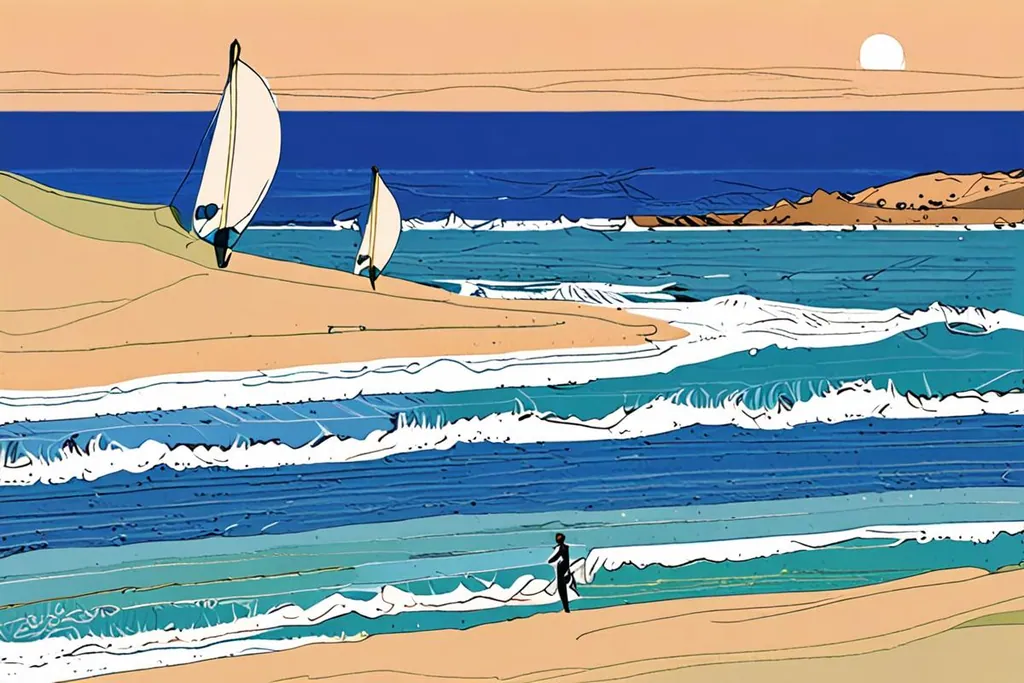
The Atlantic coast of Morocco is one beach that runs for more than two thousand kilometres, from the strait at Tangier down past Rabat, Casablanca, Essaouira and Agadir, and then on through the desert to Dakhla. Nobody treats it as one beach. The surf is in the middle, the wind is at both ends, and the long empty stretches are the ones with a village, a road and nothing else.
The other coast, the Mediterranean one in the north east, behaves like a different country: smaller, calmer, and much less visited by people who came for the ocean.
- The ride off Anchor Point, in good conditions
- 2 km
- Atlantic water off Taghazout in season
- 21 °C
- Rain a year in Dakhla
- 30.8 mm
- Sunshine a year in Dakhla
- 3,174 h
The surf coast: Taghazout and the points around Agadir
Taghazout is a fishing village nineteen kilometres north of Agadir, and it has been the centre of Moroccan surfing since the 1960s, when a beach south of the village started filling with tents, makeshift huts and camper vans. The camp is gone and hotels have replaced it, but the reason people came has not changed: a row of long right hand point breaks, in a country where the water is warmer than the swell it carries.
Anchor Point, three kilometres north of the village, is the one everybody knows. In the right conditions the ride starts there, joins Hash Point and finishes on the beach break at Panorama’s, which is something close to two kilometres of wave. The season runs from September to April, water in the same months reaches about 21 degrees, and lessons and board hire are sold in the village itself.
The whole stretch has options for every level. The beaches north of Agadir are strung along one road, and the list of them doubles as a driving plan: Tamawanza at 12 kilometres from the city, Imouran at 17, Taghazout at 19, Bouyirdn at 21, Timzguida allal at 22, Imiouadar at 27 and Aghroud at 30. Further north, Imsouane and the long beach at Taghazout Bay are the newer developments.
The wind towns: Essaouira and Dakhla
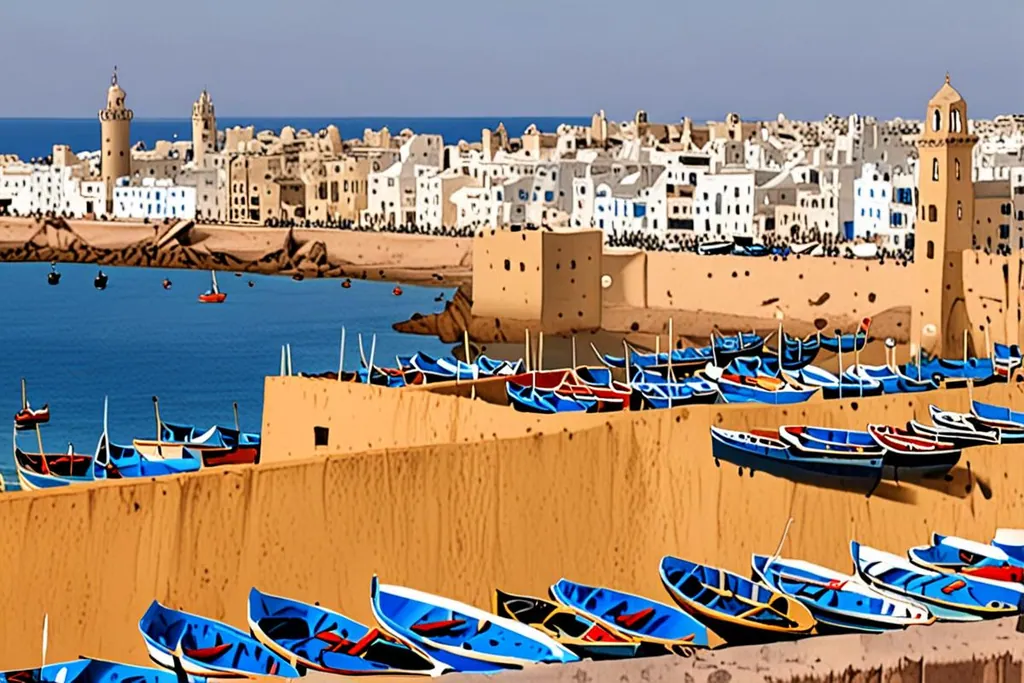
Two places on this coast are known for wind rather than surf, and they sit at opposite ends of it. Essaouira has the afternoon trade wind, which fills in most days of the year and has made the beach a windsurfing and kitesurfing destination for decades; the town behind it, with its ramparts and its fishing port, is the reason to stay a week rather than a weekend.
Dakhla is the other one. It is in Western Sahara, a territory Morocco has administered since 1979 and which is the subject of a long running dispute, and it is about as far down this coast as a road goes. Its lagoon is shallow and flat, the wind is steady, and the town has become a centre for kitesurfing and windsurfing as well as a fishing port. Hand farmed oysters go from here to restaurants in Marrakesh and Casablanca and then to Europe, and the hot spring of Asmaa, 36 kilometres away, runs at 38 degrees from a well about 700 metres deep.
Which coast suits you?
Do you want to spend the week on a board?
Do you want wind on the water as well as sun?
Taghazout and the point breaks
Nineteen kilometres north of Agadir, one village with a row of right hand points, and the season from September to April. Anchor Point is the famous one, three kilometres north, and it can join up with Hash Point for a ride of about two kilometres. Boards are hired in the village and instructors are easy to find.
Essaouira, or Dakhla in the far south
Essaouira has the afternoon trade wind and a town behind it worth the trip. Dakhla, a long drive or a short flight further south, has a sheltered lagoon, steadier wind and warmer air all year, and it has become the country’s centre for kitesurfing and windsurfing.
Oualidia, and the beaches north of Agadir
Oualidia sits with its back to a protected natural lagoon between El Jadida and Safi, and it is the calmest water on this coast. North of Agadir the answer is a beach with a number attached: Tamawanza at 12 kilometres, Imouran at 17, Taghazout at 19, Imiouadar at 27, Aghroud at 30.
The quiet water: Oualidia and the flat days
For anyone whose idea of a beach day does not include a board, the answer on this coast is a lagoon. Oualidia, between El Jadida and Safi, sits beside a protected natural lagoon and has been called the country’s oyster capital, which is a fair sign of how little the water moves there. The oysters are grown in the lagoon and eaten beside it.
Every surf town also has a shelter for the flat days. North of Agadir, the bays at Bouyirdn and Imiouadar are the ones people pick, and in the far south the entire Dakhla lagoon is waist deep for hundreds of metres. If you want the sea without the swell, aim for an estuary, a lagoon or the inside of a bay, and check what the tide does there before you plan a day around it.
The far south: the coast that does not change
Dakhla deserves its own paragraph because the numbers there are strange for anyone who knows the Atlantic. It is a mild desert, with 30.8 millimetres of rain a year falling on about five days, average daily highs that stay between 22.4 and 26.5 degrees across the whole year, 77 per cent humidity and 3,174 hours of sunshine. The Canary Current offshore moderates the temperature, which is why the same coast that feels cold in Agadir feels mild here, and it also feeds the fishing grounds.
It is more than a beach, too. The Dakhla peninsula and the bay at Cintra are among the important wintering grounds for waders on this side of Africa, the greater flamingo is common, and the flat water of the lagoon is what made the town a sailing centre. The town has an airport with a three kilometre runway and daily flights, so the far end of the country is not the expedition it used to be.
Practical notes on a Moroccan beach day
Two things about this coast are worth knowing before you pick a towel spot. The first is that the sea is cold by the standards of the countries people come from, because the Canary Current runs down the coast all year, and the air can be at 27 degrees while the water is at 19. The second is that most of these beaches have no lifeguard, and the swell that makes a point break fun also builds a current beside it.
So treat the coast the way locals do: swim where other people swim, ask at the hotel about the beach rather than the weather, and leave the rocks and the points to the people with boards. The reward is a coastline where a weekday in September leaves you a beach to yourself.
Before you book a week on this coast
0/8