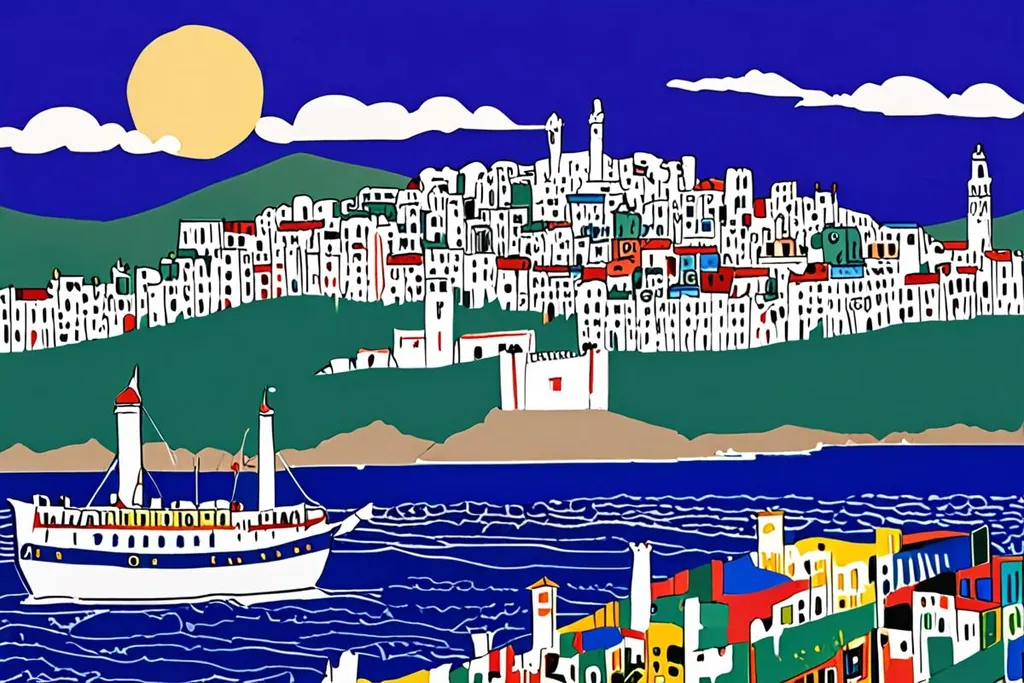
Tangier has been a port for three thousand years, which is long enough for the arrivals to stop being remarkable. Phoenicians, Romans, Portuguese, English, and then for thirty-three years an international zone run by three European powers at once, where the currency was free, the taxes were low and the spies outnumbered the diplomats.
What that history left behind is a city that faces Europe rather than the rest of Morocco. It looks north across the water, it has the country’s second port and its first high-speed railway, and it is the one place in Morocco where arriving by boat is completely normal.
- Residents, 2024 census
- 1,275,428
- Sea crossing at its narrowest
- 14 km
- Tangier to Casablanca by train
- 2h 10m
- Airport to the centre
- 15 km
A city between two seas
Tangier sits on the Strait of Gibraltar, at the point where the Mediterranean meets the Atlantic and where Africa comes closest to Europe. The strait is about fourteen kilometres wide here, and on a clear day you can see the Spanish coast from the kasbah.
The city is built on two hills with the commercial district between them, which is why it works like an amphitheatre: the old town and its citadel occupy the western hill, Cape Malabata closes the bay to the east, and the beach and the corniche run along the middle. Beyond the walls, the modern city spreads inland in the direction of the airport.
The population passed 1.27 million at the 2024 census, making it the second city in Morocco. It does not feel like it inside the medina, where the lanes are narrow, whitewashed and small enough that you can cross the whole old town in twenty minutes without once seeing a car.
When to go: a wet winter and a dry summer
Tangier is a Mediterranean city, and that means rain, which surprises people whose idea of Morocco is desert. The north takes nearly 736 millimetres a year, most of it between October and March, and summer barely sees any.
Two consequences follow. The first is that Tangier is green in a way the south is not: the Rif hills behind the city, the farms on the road to Cape Spartel, the gardens. The second is that the seasons here mirror southern Europe rather than the Sahara. Spring and early summer are the comfortable months, July and August are hot but breezy on the coast, and a winter visit is a wet-weather trip in the same sense that a winter trip to Seville is.
Rain is not the only thing the sea decides. The prevailing wind comes off the water, which keeps the city cooler than inland Morocco in summer and milder than you would expect in winter.
Arriving by ferry or by air
The ferry is the arrival that defines Tangier. Several sailings a day connect Tarifa with the Tangier-Ville terminal, and the port for the longer Algeciras crossing is Tanger Med, 40 kilometres northeast of the city and the largest port in Africa and the Mediterranean, with capacity for eleven million containers and seven million passengers. Two departures a week run from Tanger Med to Gibraltar.
If you are arriving by sea, the practical point is which terminal you booked. Tanger-Ville puts you in the city, a short walk or a very short taxi ride from the medina. Tanger Med is a port complex in the countryside, and the transfer into Tangier is a separate journey that needs its own time.
By air, Ibn Batouta airport is fifteen kilometres southwest of the centre, with Royal Air Maroc the largest carrier. It is small, quick and a straightforward taxi ride into town.
Getting around and out
For a city of its size, Tangier is unusually well connected.
The railway station, Tanger-Ville, is the northern terminus of Al Boraq, Africa’s first high-speed service, which opened in November 2018 and reaches Casablanca in about two hours ten minutes, calling at Rabat. Conventional trains continue south to Marrakesh and east to Fes and Oujda. If you are travelling the country by rail, Tangier is where the line begins.
Inside the city, the medina is a walking district and the modern centre is walkable too, along the bay and up Boulevard Pasteur. Taxis are cheap and plentiful, and the useful thing to know is that the small ones run on meters in town while the larger shared taxis on fixed routes charge per seat.
The road to Cape Spartel and the Caves of Hercules is the one trip that really wants a vehicle, because the coast road is a string of viewpoints with no practical bus service to match.
Staying online in the north
Tangier is well covered by Moroccan mobile networks, and the signal is strong along the coast, in the medina and on the routes inland. The complications are specific to how people arrive here.
If you come off a ferry, you have no airport counter to buy a SIM at, and the queues at the port are not where you want to be working out a data plan. If you come through the airport, you land into the usual choice between your own operator’s roaming, a local SIM with its registration process, and a travel eSIM installed before you left.
What makes data matter more here than in most cities is the crossing itself. A ferry booking, a boarding pass, a map from the port, a message to whoever is meeting you, and a translation when the taxi fare is being agreed: all of it happens in the first hour, usually in a queue, often with the signal dipping as the ship turns.
Six dates that made Tangier
1471
The Portuguese take the port
Tangier was occupied without a fight after the garrison fled, and most of the stone ramparts still standing around the medina date from the Portuguese century that followed.
1661
England inherits it in a dowry
Tangier came to Charles the Second with Catherine of Braganza, and the English spent two decades improving the defences before abandoning the town in 1684.
1923
The International Zone
France, Spain and Britain put Tangier under joint administration. It became a tax haven and a refuge for writers, diplomats and spies, and earned its reputation as a city outside the rules.
1956
Back in Morocco
The international zone was abolished in phases as Moroccan independence was restored, ending the most unusual period in the city’s history.
2007
Tanger Med opens
A new deep-water port 40 kilometres northeast moved freight out of the city, freed the old harbour and turned Tangier into an industrial platform for more than a thousand companies.
2018
Al Boraq
Africa’s first high-speed train began running between Tangier and Casablanca, cutting a journey of four hours forty-five minutes to about two hours ten.
What to see in a day or two
The medina first, entered through the Grand Socco and worked upward through the Petit Socco to the kasbah. The kasbah palace is now the Museum of Mediterranean Cultures, and the ramparts around it have been there in some form since the Portuguese rebuilt them in the sixteenth century.
The American Legation is the oddity worth seeking out: a mansion given to the United States in 1821, the first American public property abroad, now a museum with a wing devoted to the writer Paul Bowles, who lived in the city for half a century.
West of town, the road runs to Cape Spartel at the mouth of the strait and to the Caves of Hercules below it, where the sea has cut an opening in the rock that looks, from the right angle, like the map of Africa.
And for the view that explains the city, Café Hafa on the cliff above the sea serves mint tea on terraces stacked down the hillside, with Spain on the horizon.
On arrival, by sea or by air
0/8
Tangier rewards the slower arrival. Stay a night rather than catching the evening ferry back, walk the medina after the day trippers have gone, and let the city be the port it has always been rather than a place you passed through.