Karnak is a temple complex rather than a temple: a walled field about 2.5 kilometres north of Luxor on the east bank, containing three precincts, a dozen pylons built in sequence over centuries, chapels re-erected on the grass from the blocks of buildings that were pulled down, and one hall of columns that is the largest ever built in Egypt. The ancient Egyptians called the place Ipet-isut, the most selected of places, and it was the home of Amun, the head of the Theban triad, and the religious centre of the New Kingdom.
Construction ran from the reign of Senusret I, in the Middle Kingdom, into the Ptolemaic period: roughly two thousand years of building, demolishing, re-carving and adding. Almost every king of the 18th, 19th and 20th Dynasties did something here, and many of them made sure their names went on their predecessors’ work.
- Cột trong đại sảnh
- 134
- Diện tích đại sảnh
- 5,000 m²
- Chiều cao 12 cột lớn nhất
- 21 m
- Ước tính trọng lượng dầm ngang
- 70 tấn
The hypostyle hall
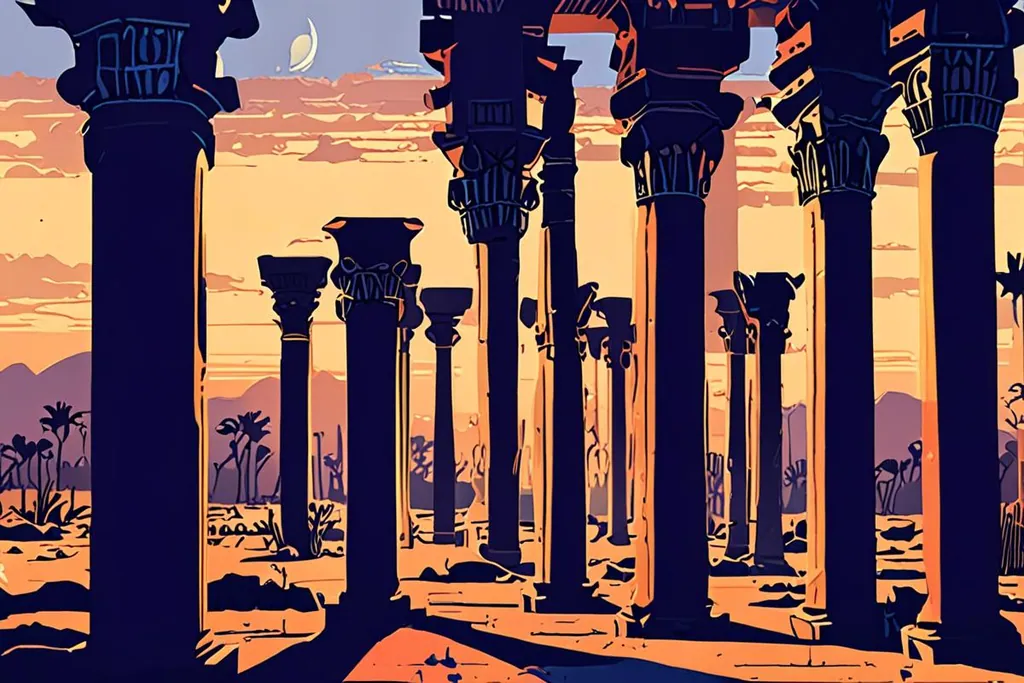
The Great Hypostyle Hall is what most people come for, and it justifies the trip on its own. It covers 5,000 square metres with 134 columns arranged in sixteen rows: 122 of them ten metres tall, and twelve rising to around twenty-one metres with diameters over three metres, carrying architraves estimated at seventy tons each. The effect of walking in is not of a room but of a stone forest, and the light coming through the clerestory openings above the side rows is what makes it work.
It was begun under Seti I and completed by Ramesses II, whose reliefs cover the walls, and the carvings were originally painted: traces of colour survive in the sheltered corners. In a back corner of the site stands an unfinished column, with the drum left rough, which is the clearest explanation anywhere of how these things were dressed and decorated after they were stacked rather than before.
The obelisks, the lake and the open air museum
Hatshepsut raised a pair of granite obelisks at Karnak, and one of them still stands, around 29 metres of it, because later kings chose to wall it in rather than cut it down; its companion lies on its side nearby. Beyond, the sacred lake is a rectangle of water with stone steps, used by the priests for purification, and beside it the scarab beetle on its pedestal that appears in every visitor photograph.
The open air museum at the rear of the precinct is the part people skip and should not. The White Chapel of Senusret I and the Red Chapel of Hatshepsut have been rebuilt there from their own blocks, and because they were found as fill inside later monuments, their decoration survived. This is where the Middle Kingdom part of Karnak’s story actually lives.
Two of the three precincts, those of Mut and Montu, are usually closed, and a good deal of the site is still being excavated and restored, so the map changes from year to year.
Hai ngàn năm xây dựng
Thời Trung Vương quốc
Khởi đầu khiêm tốn
Việc xây dựng bắt đầu từ triều Senusret I, khoảng 1971-1926 TCN, trên nền một khu vực đã là đất thiêng từ trước. Phần còn lại của giai đoạn này chủ yếu nằm ở bảo tàng ngoài trời, nơi nhà nguyện Trắng đã được dựng lại từ các khối đá gốc.
Thời Tân Vương quốc
Các vua cạnh tranh
Từ vương triều thứ 18, mỗi triều đại đều xây thêm cổng, sân, đền, obelisk mới; nhiều vua còn khắc lại tên mình trên công trình của các vua trước. Nữ hoàng Hatshepsut dựng một đôi obelisk ở đây, một chiếc vẫn còn đứng giữa khu vực, được bảo vệ nhờ các công trình sau xây bao quanh thay vì tháo dỡ.
Vương triều 19
Đại sảnh cột
Seti I khởi công Đại Sảnh Cột và Ramesses II hoàn thiện: 134 cột chia làm mười sáu hàng, mười hai cột trung tâm cao khoảng hai mươi mốt mét, trên đỡ các dầm ngang nặng khoảng bảy mươi tấn. Trên một góc còn một cột dở dang, cho thấy rõ cách hoàn thiện bề mặt các cột sau khi chồng lên nhau.
Amarna và sau đó
Một đền bị tháo dỡ
Amenhotep IV, sau này là Akhenaten, xây một đền thờ thần Aten ở Karnak nhưng sau khi ông mất, nó bị cố ý tháo dỡ. Các khối đá của đền được dùng làm vật liệu xây các cổng về sau, nhờ đó mà chúng còn nguyên cho đến ngày nay để tái dựng lại. Việc xây mới ở Karnak còn tiếp tục đến thời Ptolemaios, sau khi Tân Vương quốc kết thúc.
1979 và 2021
Di sản thế giới và đại lộ
Thebes và khu nghĩa địa, bao gồm Karnak, được UNESCO công nhận năm 1979. Năm 2021, đại lộ tượng nhân sư đầu cừu nối Karnak với đền Luxor được mở lại sau nhiều năm khôi phục, khôi phục đoạn đường dài hai kilomet lần đầu tiên sau nhiều thế kỷ.
Walking it in the right order
Enter from the west through the first pylon, into the great court with its colonnades and the temple of Ramesses III on the left, then into the hypostyle hall. From there, east: the obelisks, the sanctuary and the halls around it, which are the oldest and most sacred part of the complex. Then back around the northern side to the sacred lake, and finish in the open air museum.
If you have one day in Luxor and a taste for Egyptian religion rather than tombs, do Karnak in the morning and Luxor Temple in the late afternoon, walking or driving the avenue of ram-headed sphinxes that connects them. Karnak was the dwelling of the god; Luxor Temple was where he went once a year during the Opet festival, and the two together are one story rather than two monuments.
Bạn sẽ đi theo cách nào?
Bạn đã tìm hiểu trước về di tích này chưa?
Bạn có muốn đi cả đền Luxor trong ngày không?
Đi cùng hướng dẫn viên hoặc thuê audio guide
Karnak giống một bản nháp lịch sử: thay đổi qua mọi triều đại suốt hai ngàn năm, và hầu như tại chỗ không có giải thích rõ ràng. Hướng dẫn viên có phép trong hai tiếng, hoặc audio guide, sẽ giúp bạn hiểu vì sao đại sảnh được xây như bây giờ, thay vì chỉ đơn giản là một cuộc dạo bước qua di tích ấn tượng.
Karnak buổi sáng, đền Luxor lúc chiều tối
Bắt đầu ở Karnak ngay khi mở cửa, sau đó đi bộ trên đại lộ nhân sư hoặc đi taxi sang đền Luxor. Hai đền này gắn kết thành một câu chuyện: Karnak là nơi ngự của thần Amun, còn đền Luxor là nơi ngài đến mỗi dịp lễ Opet. Đi cả hai trong ngày sẽ nối kết mạch truyện lại.
Tham quan Karnak riêng biệt, không vội vàng
Dành khoảng ba tiếng cho khu vực chính Amun-Re và hãy đi tuần tự: vào cửa chính, qua sân trước, đến đại sảnh cột, tiếp đó là khu obelisk, đền thờ chính, rồi hồ thiêng và bảo tàng ngoài trời nơi các nhà nguyện được phục dựng. Kết thúc ở hồ và tượng bọ hung, góc yên tĩnh nhất của khu di tích.
Practicalities
Karnak is the busiest site on the east bank and the one where timing matters most, because there is almost no shade: gates open early, the coach groups arrive from about ten, and by noon the stone is giving the heat back. Two to three hours covers the precinct of Amun-Re properly; half a day covers it and the museum.
The sound and light show runs most evenings and divides opinion, but it is the only way to be inside Karnak at night with the crowds gone, which is worth something. And take a guide or the audio tour: this is a site where the buildings are the least interesting part of the story, because the story is about who rebuilt whose work and why.
Trước khi vào khu vực chính
0/8
Karnak is the opposite of the Valley of the Kings. There, everything is hidden and small and underground. Here it is all on the surface, scaled to impress, and built to be seen from a distance. Go at opening, walk it in order, and save the lake for last.