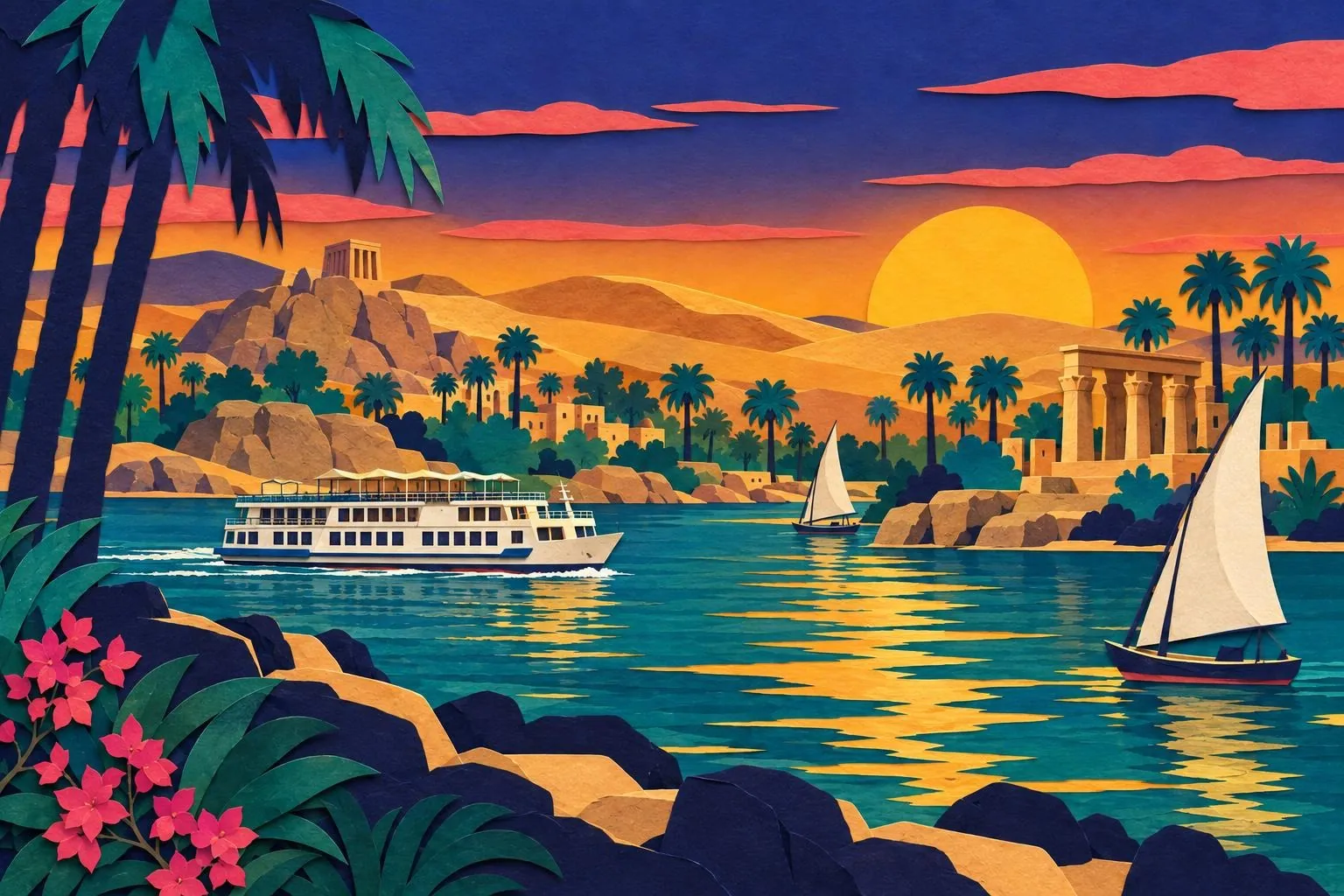
The Nile is the reason Egypt exists as a country rather than as a desert, and a cruise along it puts you on the water that made the civilisation you have come to see. It is also the only way to move between Luxor and Aswan without packing and unpacking, which is worth more than it sounds.
What follows is the shape of the trip rather than a sales pitch, including the part the brochures leave out.
- Đêm, thường gặp
- 4 đến 5
- Đền thờ dừng trên hành trình
- 3
- Chiều dài sông Nile
- 6,650 km
The route
The classic route runs between Luxor and Aswan, and it can be done in either direction. Luxor is where the temples of Karnak and Luxor stand within the same city, with the Valley of the Kings and the Valley of the Queens across the river on the west bank. Aswan is quieter, Nubian rather than Pharaonic in feel, with Philae temple, the High Dam and the classic place on the river for a felucca sail.
In between are three stops that give the trip its rhythm: Esna, where the boat passes through a lock, and Edfu and Kom Ombo, each with a temple you reach on foot from the mooring.
Four or five nights is the usual length. Three is workable and rushed. Seven gives you time in both cities as well as the river.
Lịch trình chi tiết
Ngày 1
Luxor và quy mô choáng ngợp
Đền Karnak và đền Luxor, đều rất rộng lớn, thường được thăm vào buổi chiều muộn khi trời đã dịu nóng.
Ngày 2
Bờ tây
Thung lũng các vị Vua, Thung lũng các Hoàng hậu và đền Hatshepsut, sau đó tàu sẽ di chuyển về phía nam khi bạn đang ăn.
Ngày 3
Esna và Edfu
Qua âu tàu Esna, ghé thăm đền Horus ở Edfu, được bảo tồn nguyên vẹn do từng bị cát bao phủ suốt nhiều thế kỷ.
Ngày 4
Kom Ombo và Aswan
Đền đôi hiếm hoi thờ hai vị thần, nằm ngay bên sông, sau đó đến Aswan và vùng Nubia của sông Nile.
Ngày 5
Aswan hoặc Abu Simbel
Đền Philae và Đập Cao Aswan, hoặc một chuyến đi rất sớm xuống Abu Simbel, bằng xe theo đoàn hoặc chuyến bay ngắn.
What the days actually look like
A cruise is a package with a timetable, and the sooner you accept that, the more you enjoy it.
Sailing happens while you eat and while you sleep. The daytime is for excursions, usually early in the morning and again in the late afternoon, with the hot middle of the day spent back on the boat. Breakfast is early when there is a morning excursion, which in practice means most mornings.
That timetable is not incidental. It exists because the sites are unpleasantly hot in the middle of the day and because the boat has to keep to its schedule through the lock at Esna, where traffic queues. It suits most people, including families, and it is the opposite of independent travel. If you want to spend three hours alone in the Valley of the Kings, a cruise will not give you that.
The mooring, and what nobody mentions
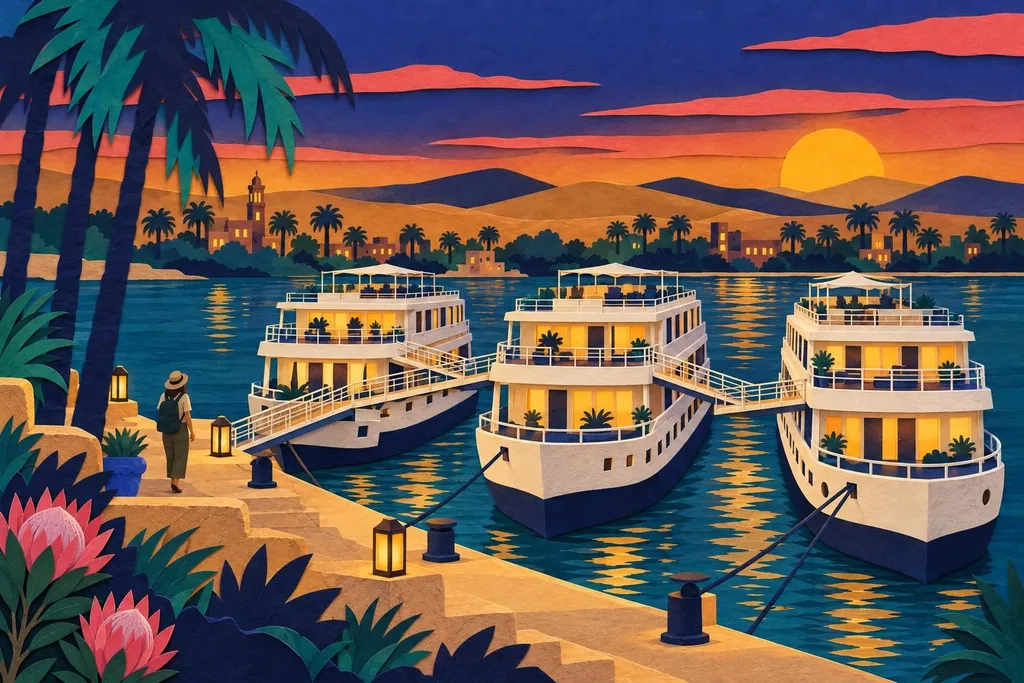
Here is the detail that surprises everyone. Cruise boats moor side by side, often four or five abreast, so the boat next to the bank is not necessarily yours.
That means getting ashore can involve walking through the lobbies of three other boats, which is a strange experience the first time and completely normal by day three. It also means the view from your cabin window may be another cabin window, which is a real consideration when you choose a cabin.
If a view matters to you, that is the argument for a cabin on the upper deck, and for asking specifically where the boat tends to moor.
Doing the same route without a boat
The cruise is a way of arranging the trip rather than the only way to see it, and it is worth knowing what the alternative looks like.
Luxor and Aswan are connected by road, rail and air. The train is comfortable and cheap, the flight is short, and a private driver for the leg is a common arrangement. You can base yourself in each city for three or four nights and take day trips from there, which costs less than the boat and is considerably more flexible.
What you lose is the logistics being handled for you. A cruise moves you while you sleep, produces a guide at each site and removes every decision about how to get somewhere. What you gain, without it, is the ability to stay in the Valley of the Kings until the light changes, which no timetable allows.
For a first visit with limited time, the boat is the easier introduction. For a second visit, or for anyone who has travelled in Egypt before, the independent version usually wins.
Choosing a boat and a cabin
The fleet runs from comfortable to genuinely luxurious, and the difference in price is larger than the difference in itinerary, because the itinerary is fixed by the river and the lock.
Two practical choices matter more than the star rating. A cabin above the waterline and away from the engine is quieter, which matters more than people expect on a boat that moves at night. And a boat with fewer cabins means fewer people at every site, which is worth something in the Valley of the Kings.
When to go
October to April is the comfortable season, and December and January are the coolest and busiest. The summer months are hot enough to make the middle of the day genuinely unpleasant, with Luxor regularly above forty degrees, and the boats are quieter and cheaper as a result.
If your only window is summer, a cruise is still a reasonable choice, because you retreat to air conditioning between excursions, but plan on doing very little between eleven and four.
Chuẩn bị đồ và lập kế hoạch cho chuyến du thuyền Nile
0/9
Two last practical notes. Entrance fees at the major sites are often not included in the cruise price, and they add up, so check before you book and budget separately. And the crew and the guide expect a tip at the end, which is normal, is not included, and is easier to handle if you have kept the cash aside rather than spent it on the last evening.