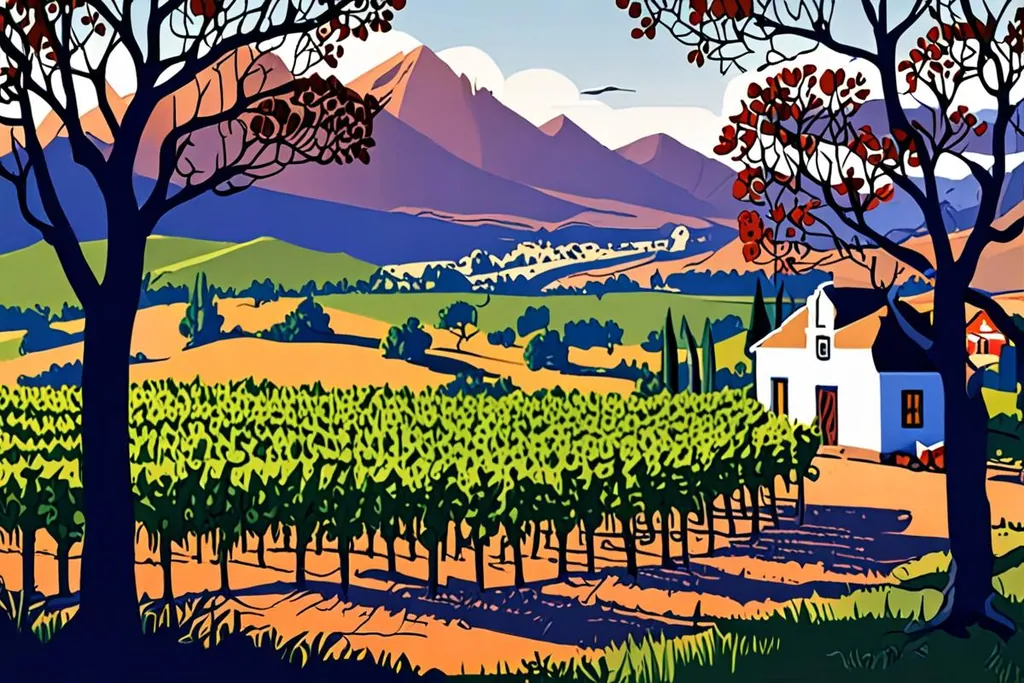
Stellenbosch is fifty kilometres east of Cape Town, on the Eerste River at the foot of the mountain that shares its name, and it has been a town since 1679, which makes it the second oldest in the country. Simon van der Stel, who founded it, planted oaks along the streets, which is why it is still called Eikestad, the city of oaks, and why the centre is a grid of whitewashed gables and deep shade.
It is also the centre of the Cape winelands, with estates on every road out of town and a university filling the place with students. That combination, a historic town surrounded by farms that welcome visitors, is why it is the default day out from Cape Town and the base most people choose for two or three nights in the winelands.
- Năm thành lập thị trấn
- 1679
- Khoảng cách tới Cape Town
- 50 km
- Thị trấn lâu đời thứ hai ở Nam Phi
- 2nd oldest
- Pinotage được lai tạo tại đây
- 1925
How the wine route works
The Cape winelands are not one route but several areas: Stellenbosch and its suburbs, Franschhoek over the pass, Paarl and Wellington to the north, Constantia inside Cape Town itself, and the cool coastal strip at Elgin and Hemel-en-Aarde near Hermanus. Each has its own character and its own grapes, and trying to cover two of them in one day means spending the day in the car rather than at a table.
Within an area, the practical unit is the estate. You arrive, you pay a tasting fee, you are given a flight of four to six wines and often a short explanation, and you can then buy bottles, eat at the estate restaurant, walk in the garden or leave. Some estates run seated, hosted tastings with a sommelier for a higher fee, which is worth doing once at a cellar you care about.
Tasting, eating and what it costs
Tasting is paid for almost everywhere now, with the fee often discounted against a bottle purchase, and the range between a standard flight at a farm and a hosted flagship tasting at a famous estate is wide. Budget a fee per estate and treat the wine you buy as separate, and check the closing times, because tasting rooms tend to shut in the late afternoon while the restaurants carry on into the evening.
The food is a large part of the point. Almost every serious estate has a restaurant, from a deli counter to a long-lunch destination that people book months ahead, and the winelands are where Cape cuisine does its showing off: Cape Malay influences, Italian, bistro cooking and a great deal of grilled meat. Book lunch first and build the day around it rather than the other way round.
The drive, and getting back
There is no useful public transport between the estates, and the roads are rural, fast and unlit. The legal blood alcohol limit is low, the penalties are serious, and the police run checks on the wine route roads at weekends, which is why almost everyone sensible books a driver.
The options, in order of how well they work: a booked small group tour, which costs the least per head; a private driver or a shuttle service, which is flexible; and self driving with a designated driver who spits. There is a tram in Franschhoek that connects estates, which is the exception, and a few operators run hop-on shuttles between Stellenbosch farms. Whatever you choose, arrange the return before you start drinking rather than at six in the evening when everybody else is also looking for a car.
Where to stay, and how long
Stellenbosch itself is the practical base: a walkable historic centre, hotels and guesthouses in the old streets, the university giving it life in term time, and the wine routes starting at the edge of town. Franschhoek, thirty minutes over the pass, is the smaller and prettier alternative, with a restaurant strip that people plan holidays around. Paarl and Wellington to the north are quieter and cheaper, and Constantia, inside Cape Town, is the option for anyone who wants vineyards without leaving the city.
Two nights is the sensible minimum: an afternoon on arrival to walk the town and eat, a full day of estates with lunch in the middle, and a morning for the farm you liked enough to return to. Three nights lets you add Franschhoek or a day in the mountains behind the valley. One night is enough to taste the region and not enough to relax into it, and many people regret treating the winelands as a single stop between Cape Town and the Garden Route.
Book early for the weekends between October and April, when Capetonians drive out for lunch, and check whether the estate you want opens on a Sunday. Some do, spectacularly; some close.
What to drink, and what to take home
Chenin Blanc is the Cape’s signature white and the grape most planted here, and Sauvignon Blanc from the cooler coastal districts is the other one to try. Cabernet Sauvignon and Syrah are the serious reds of Stellenbosch and Paarl; Pinotage is the local grape, bred in South Africa in 1925 and worth one glass so that you have an opinion. Cap Classique, the Cape’s bottle-fermented sparkling wine, is made to the same method as champagne and costs a fraction of it.
If you are carrying bottles home, check your airline allowance and pack them properly, and check the duty-free rules for your own country before you fill a case.
Bạn sẽ khám phá tuyến rượu vang như thế nào?
Bạn có sẵn sàng trả tiền cho tài xế hoặc tour không?
Bạn có muốn ăn trưa dài vào giữa ngày không?
Ba trang trại và bữa trưa kéo dài
Đặt chỗ ăn trưa trước, vì các nhà hàng nổi tiếng thường kín chỗ hàng tuần, rồi lên kế hoạch quanh bữa trưa: một điểm thử rượu buổi sáng muộn, rồi ăn trưa, buổi chiều thêm một đến hai điểm nữa. Đặt tài xế hoặc tour nhóm nhỏ để tiện đi lại, tránh phải lo lắng ai cầm lái về khi trời tối.
Bốn lượt thử rượu, không ăn trưa
Thử rượu buổi sáng đến đầu giờ chiều, và nên ăn no trước khi bắt đầu, vì bốn lượt thử rượu khi đói sẽ rất chóng mệt. Chọn các trang trại nằm cùng tuyến, cách nhau dưới mười phút, ưu tiên thử tiêu chuẩn thay vì thử cao cấp, và dùng chậu nhổ rượu thoải mái vì nhân viên đã quen với việc này.
Tự lái xe, thử rượu thận trọng
Nếu tự lái, cách hợp lý duy nhất là thử rồi nhổ ra, chia set thử cho người ngồi cùng, và chỉ đi hai nơi thay vì bốn. Đường giữa các trang trại nhìn bản đồ tưởng gần nhưng thực tế không như vậy, hầu hết không đèn đường, và đường nông thôn lúc chiều muộn sau bữa trưa dài là hoàn cảnh mà luật pháp để ý nhất.
Trước khi khởi hành tuyến rượu vang
0/8
The winelands are the most pleasant day in South Africa that does not involve a mountain or an animal, and they go wrong in exactly one way: too many estates, too little food, and the last one driven. Book lunch, book a driver, choose three farms and stop, and the day will look after itself.