The Valley of the Kings is a dry wadi on the west bank of the Nile at Luxor, under a pyramid-shaped peak the ancient Egyptians called the Peak, and it is the reason most people come to Egypt at all. For about five hundred years the kings of the New Kingdom were buried here, cut into the rock rather than stacked up in pyramids, and the results are corridors and chambers whose walls are covered from floor to ceiling with painting and relief. Sixty-five tombs and chambers are known. Eighteen of them can be opened to visitors, rarely on the same day, and a single ticket covers three.
What surprises people is how small the place is. The East Valley is a few minutes’ walk from end to end, the interiors are narrow, and the two and a half thousand years since the last burial have been unkind: almost every tomb was opened and emptied in antiquity. What is left is the decoration, which is why the valley rewards an hour spent learning the names before you go in, and not the other way round.
- Tombs and chambers known
- 65
- In use, 1539 to 1075 BC
- 500 years
- That can be opened, not at once
- 18
- Visitors on a usual day
- 4,000 to 5,000
Why here, and why like this
The old answer to the pyramid problem was that a pyramid announces where the treasure is. The New Kingdom’s answer was to hide the burial in a place with one entrance and no landmark worth the name, guarded by a corps of tomb police and by distance from the river. The peak above the valley even looks like a pyramid, and the first kings to build here were probably reading the landscape that way.
Only about twenty of the tombs actually held a king. The rest are the burials of favoured nobles, of queens and of royal children, plus caches, embalming pits and pits whose purpose nobody agrees on. KV5, the tomb Ramesses II enlarged for his sons, has more than 120 known chambers and is still being excavated; at the other end, KV54 is a pit.
The rock decided a great deal of it. The valley sits over more than a thousand feet of limestone and softer sedimentary rock, laid down between 35 and 56 million years ago, and its layers change quality within metres. Esna shale expands when it gets wet and pushes the surrounding stone apart, so the excavators adjusted the shape and size of a tomb to the rock they met, which is why some plans turn a corner for no visible reason. The workers themselves lived in the village of Deir el-Medina in the next wadi, and their records are so good that we know about their rations, their days off, and the first strike in recorded history.
The shapes, and how they changed
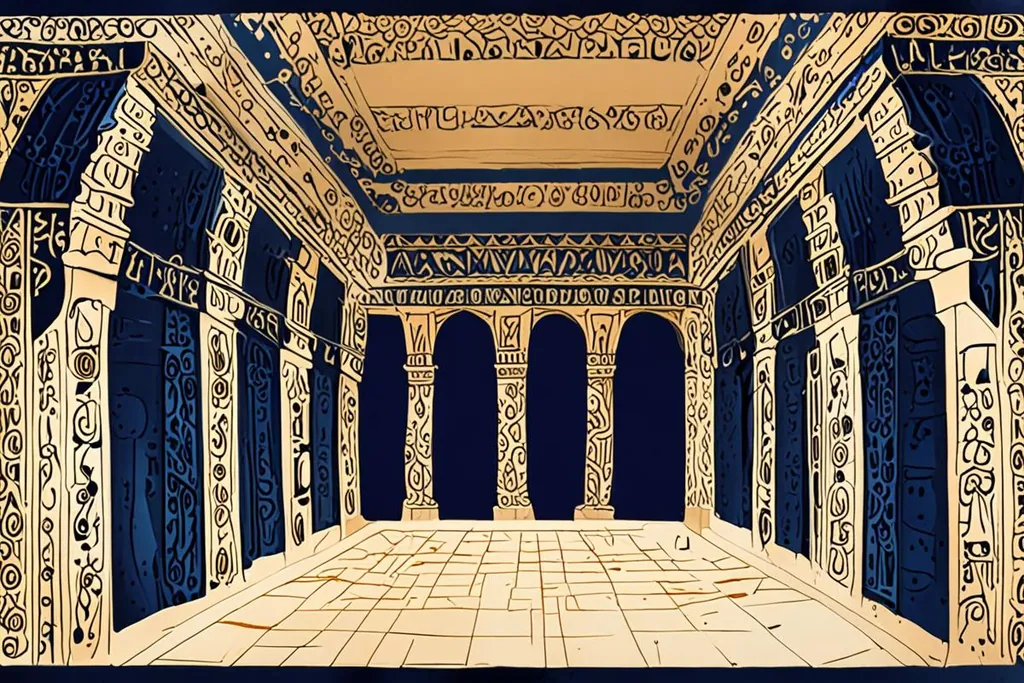
An early 18th Dynasty tomb runs down a corridor and turns, once or more, to reach the burial chamber on what is called a bent axis. The turn may have been practical and may have mirrored the sun god’s descent into the underworld; the burial chambers of these first tombs are often cut in the shape of a cartouche. After the Amarna period the plans jog rather than bend, with the tomb of Horemheb a good example, and by the late 19th and 20th Dynasties they run straight, with almost no slope at all.
Most tombs include a well: a shaft in the floor of a corridor. It began as a barrier against flood water reaching the burial and later turned into a symbol, kept in the plan even when it was never dug, which is the sort of detail that tells you how much ritual had become decoration.
The decoration follows the same arc. The earliest tombs carry scenes from the Amduat, the journey of the sun through the twelve hours of night, and they are sparsely painted. From Horemheb onwards comes the Book of Gates, then the Book of Caverns, then the Book of the Earth in the tomb of Ramesses III, with the Book of the Heavens spread across ceilings from the time of Seti I. The point of all of it is the same: a map, painted on the walls of a dark room, for a journey the king was expected to make.
Everyone kept declaring it finished
1799
Napoleon’s surveyors
Members of the French expedition drew plans of the tombs that were known then and mapped the Western Valley, where the tomb of Amenhotep III was located. The Description de l’Égypte gave the site two of its twenty-four volumes.
1817
Belzoni calls it exhausted
Working for the British consul Henry Salt, Giovanni Belzoni found the tomb of Seti I and cleared it, and afterwards announced that every tomb had been located and nothing of note was left. He had, in the same stretch of years as everyone else, missed the one that mattered.
1827
The numbering that stuck
John Gardner Wilkinson painted KV numbers over the doorways of the 21 tombs then open, starting at the valley entrance and working southward, with four more marked WV1 to WV4 in the West Valley. Every discovery since has been added to his list, which now runs to KV64.
1907
Davis calls it exhausted too
Theodore Davis held the excavation permit, found KV55 and the royal tombs of the 18th Dynasty, and published a book in 1912 closing with the line, I fear that the Valley of Kings is now exhausted. Eight years later his concession passed to Lord Carnarvon.
1922
The step in the ground
Howard Carter, working for Carnarvon, found the tomb of Tutankhamun on 4 November and spent another ten years clearing and conserving it. It was the first royal tomb found that had survived largely intact, and it made a minor king the most famous pharaoh in the world.
2005 and 2011
And still not finished
KV63, a chamber of embalming material, was found in 2005, and KV64 in 2011. Radar work on the valley floor still turns up shelves and anomalies, so the count of 65 is a statement about scholarship rather than about the rock.
Which tombs, and how to choose
Your ticket covers three tombs in the East Valley, and you choose them at the gate. Most people walk to the famous names; a better morning is one tomb from each period. Take an early bent-axis tomb such as Thutmose III or Thutmose IV for the corridor and the sense of descent, a 19th Dynasty tomb for the relief and the colour, and a late 20th Dynasty tomb such as Ramesses IX or Ramesses VI for length and the graffiti left by Roman and Coptic visitors, of which KV9 has more than a thousand.
Three tombs charge separately. Seti I, KV17, is the one people build a day around, with relief carving and painting through a long corridor; it is also the tomb that floods and closes most often, so it is worth checking at the gate before you set your heart on it. Tutankhamun, KV62, is small, and the value is in standing in the room rather than in the scale. Ay, in the West Valley, is a separate trip across the ridge and almost always empty.
The rest of the practical advice is about time. Gates open early in the summer and the coach groups arrive from about ten, so the first two hours are worth more than the next four. Guides are not allowed to lecture inside the tombs, and visitors are asked to move through quietly and in single file, which suits everyone in a room the size of a small corridor with four thousand years of paint on the walls.
How much of the valley will you do?
Is this your first visit to an Egyptian tomb?
Can you be at the gate before eight in the morning?
Three tombs, first through the door
Buy the standard ticket, which covers three tombs of your choosing, and go straight in at opening. Choose by shape rather than by fame: an early bent-axis tomb for the corridor, a 19th Dynasty tomb for colour, and one of the long straight-axis tombs for scale. You will have the first two almost to yourself.
Three tombs, and expect company
If you arrive with the coach groups, the tombs still work but you will file through them in single file with a guard hurrying you. Guides are no longer allowed to speak inside the tombs, so read up on the way in and look at the walls rather than listening to anyone.
Add Seti I or Tutankhamun
With the basic ticket done once before, the extra charges start to make sense. Seti I gives you the deepest relief carving and the longest walk through decorated corridors; Tutankhamun gives you a small, crowded, painted burial chamber and the king himself. The West Valley tomb of Ay needs its own ticket and almost nobody goes.
Getting there, and the heat
The west bank is reached by the public ferry from Luxor or by road over the bridge, and then by taxi, minibus, bicycle or a long walk past the Colossi of Memnon. Every hotel and driver in Luxor sells a west bank day that strings the valley together with the temple of Hatshepsut and the Colossi, which is the sensible way to do it if you have one day and no car.
There is no shade to speak of between the car park and the tomb entrances, and the interior of a tomb is hotter than the air outside once a crowd is in it. Water, a hat and a finish before midday are the whole strategy. And a note that belongs in every Egyptian itinerary: the 1997 attack at Deir el-Bahari, which killed 58 tourists and four Egyptians, is why the west bank has the security it does today, and why the road up the hill is closed to private cars.
Before the west bank
0/8
The valley is the one place in Egypt where the crowd is part of the design: the tombs are small, the paint is fragile, and everybody wants the same twenty minutes. Go early, choose by period, pay for one premium tomb rather than three ordinary ones, and leave the middle of the day to the river.