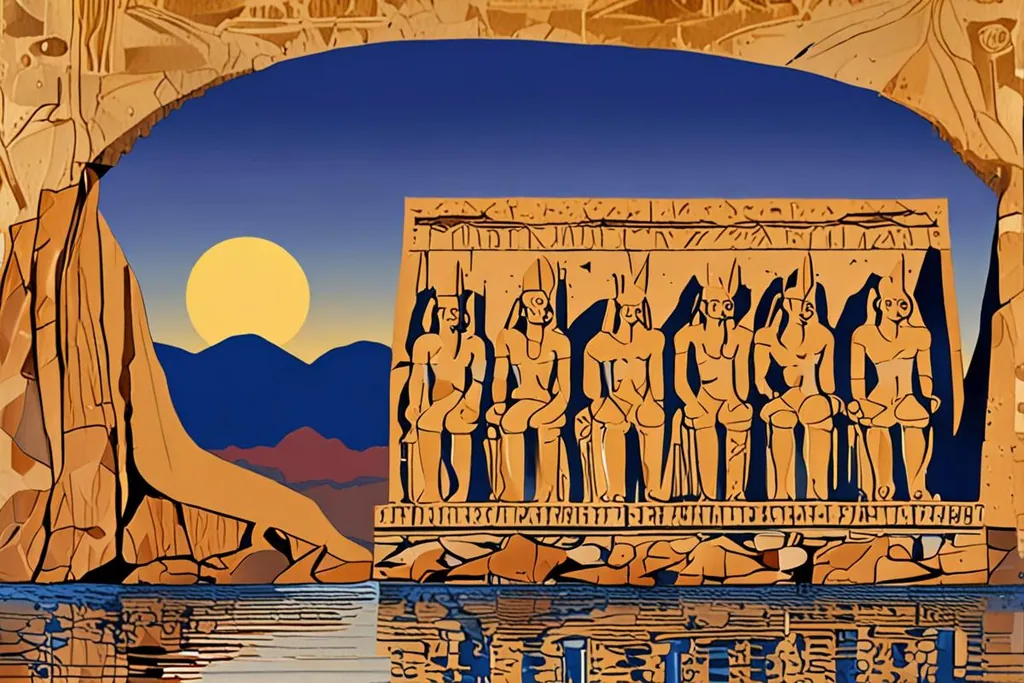
Abu Simbel is two temples cut into a cliff beside Lake Nasser, a few hours south of Aswan and not far from the border with Sudan, and it is the one monument in Egypt that no photograph prepares you for. Four seated figures of Ramesses II look east over the water, twenty metres from base to crown, with a frieze of twenty-two baboons above them greeting the rising sun. Beside them, a hundred metres away, is a smaller temple where the king and his queen stand at exactly the same height, which in Egyptian art is close to a scandal.
The site sits just south of the Tropic of Cancer, on the western bank of the lake, about 230 kilometres south west of Aswan as the crow flies and roughly 300 by road. Nobody passes through on the way to somewhere else. That is the whole practical question about Abu Simbel: how to get there, and how much of a day to give it.
- Each seated colossus
- 20 m
- Height of the facade
- 33 m
- Blocks in the rescue
- 1,036
- From Aswan, by air
- 230 km
Two temples in one cliff
The Great Temple was dedicated to Amun, Ra-Horakhty and Ptah, and to Ramesses himself as a god, which is the sort of thing Ramesses did. Construction started in about 1264 BC and took some twenty years. The facade is 33 metres high and 38 wide, carrying the four colossi, and the second figure from the left lost its head and torso in an earthquake shortly after the temple was finished. When the temple was moved, the decision was to leave the fallen pieces where they had come to rest, at the statue’s feet, rather than glue the pharaoh back together.
Inside, the layout follows the usual Egyptian plan of rooms shrinking towards the sanctuary, with an unusual number of side chambers. The hypostyle hall is 18 metres long and 16.7 wide, held up by eight pillars carved as Osiris figures of the king, and the walls carry the battle reliefs of Kadesh, with Ramesses in his chariot shooting at men who are already running.
The Small Temple is dedicated to Hathor and to Nefertari, and it is the second temple in Egyptian history to be given to a queen: the first was the one Akhenaten built for Nefertiti. Its statues are a little over ten metres high, and the king and queen are the same size. Everywhere else in Egypt, a queen stood beside her pharaoh and never above his knees.
The morning the sun arrives
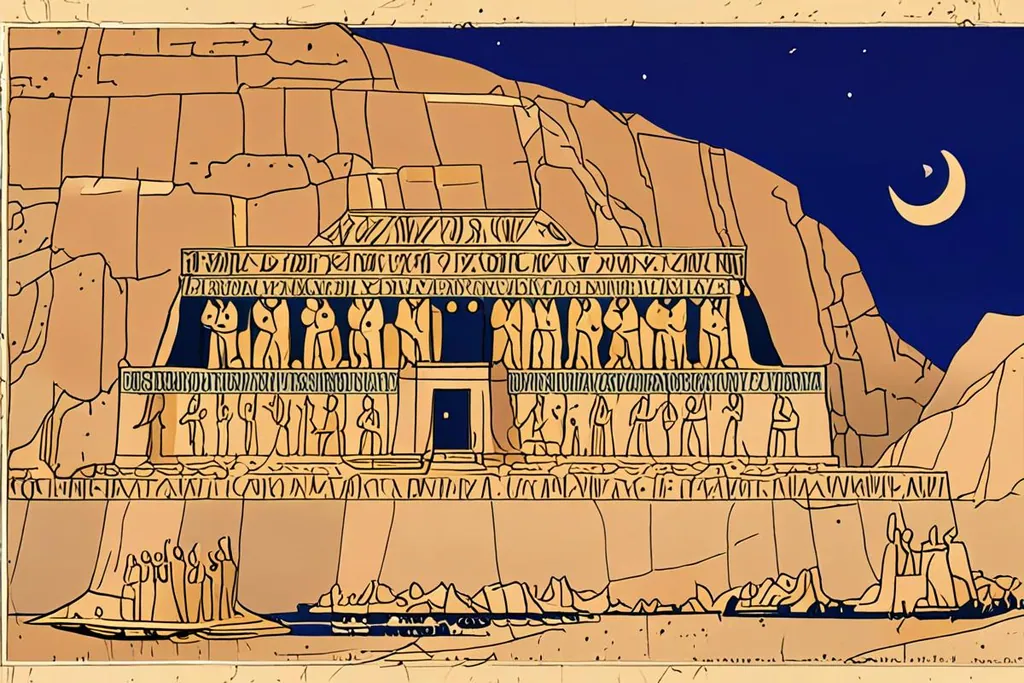
The axis of the Great Temple was set so that on two days a year the rising sun sends a beam straight down the corridor, 63 metres, into the sanctuary at the back, where it lights three of the four seated figures on the wall: Ra-Horakhty, the deified Ramesses, and Amun-Ra. The fourth, Ptah, is the god of the underworld and stays in the dark, which is either a piece of theology or a piece of stagecraft, and probably both.
Those days are 22 October and 22 February, and they are the reason people book a year ahead for a hotel in Aswan. The dates are usually explained as the king’s birthday and his coronation, though there is no inscription that says so. What is certain is that the effect mattered enough to be rebuilt: the temples were realigned on their new site to preserve it, and the team gathered at sunrise on 22 February 1966 to watch the beam light Amun, Ra and Ramesses while Ptah remained in shadow. Two thousand years of the earth’s axial precession have moved the date since the temple was cut, and the move has shifted it again, so the modern alignment is a good copy rather than the original.
The rescue, in order
1959
A campaign, not a project
The Aswan High Dam would raise the lake by up to sixty metres at Abu Simbel, and sandstone weakens once it is submerged. UNESCO began the International Campaign to Save the Monuments of Nubia and asked the world for schemes.
1962
Three answers, one chosen
One proposal kept the temples where they were behind a 73 metre concrete dam with filtered water. Another lifted them on hydraulic jacks. The third, from the Swedish firm VBB, cut them into blocks and rebuilt them higher up, for about half the price.
1963 to 1964
A coffer dam against the lake
Work began with a dam 370 metres long and 25 metres high around the temples, built in three shifts around the clock, and pumped by 25 pumps moving 750,000 gallons an hour while the sandstone faces were injected with epoxy resin.
1964 to 1966
1,036 blocks
Italian stone cutters, many from the marble quarries at Carrara, cut by hand where the surfaces had to match. Blocks were capped at 20 tons inside and 30 on the facades. The first was lifted on 21 May 1965 and the last on 16 April 1966, with nothing seriously damaged.
1968
Higher ground, and a hill on top
The temples were rebuilt 208 metres inland and 65 metres higher, over concrete domes filled with an artificial hill of 300,000 tons of rock from the original site. The pair was inaugurated on 22 September 1968, and the campaign helped produce the World Heritage List.
Getting there, and staying the night
Most people come from Aswan, which is the nearest city and the base for the whole of Egyptian Nubia. The road runs about 300 kilometres through open desert; the alternative is a flight into Abu Simbel Airport, two kilometres from the temples, with year-round services from Aswan and seasonal ones from Cairo. Fittingly, the airport was built on the larger of the two storage areas used during the rescue, so you land on the ground where the temple once lay in pieces.
There is not much of a town. Some people stay a night to see the temples twice, at sunset and again at dawn, and to have the place to themselves when the coaches leave; the rest do it as a long half day and sleep in Aswan. Either way, the visit itself is short: an hour or two walking the facades and the interiors, more if you sit and let the scale settle.
Staying online
This is the most remote place on the usual Egyptian circuit, and the one where a downloaded map and an offline ticket matter. Data works in Aswan and along the road, and coverage at the temples is patchy by any standard, so arrange everything before you leave the city: the booking, the map, the message home.
The choice is the same as anywhere in Egypt, and it favours the eSIM here more than it does in Cairo. A local SIM means a counter in Aswan on the day you would rather be on the road. Roaming works and costs. An eSIM installed at home is live when the car stops at the gate.
How will you get there?
Are you staying in Aswan anyway?
Can you leave before dawn without resenting it?
The road from Aswan, early
The drive is about 300 kilometres each way through open desert, and the reward for the early start is arriving as the light comes across the facades and before the coaches. Take water and something to eat, because the site is not a place to spend the middle of the day looking for lunch.
Fly in for the morning
The airport is two kilometres from the temples, with year-round flights to Aswan and seasonal ones to Cairo. It turns a long day into a short one, and it is the answer for anyone with a tight itinerary or a dislike of four hours in a minibus with the air conditioning on full.
Aswan first, then decide
If you are not staying in Aswan, get there first: it is the base for the temples, the Nile, the Nubian villages and the boats, and every option for Abu Simbel starts from it. From Aswan the trip books itself in a hotel lobby, and the choice between road and air is then yours on the day.
Before the drive south
0/8
Abu Simbel is the least complicated site in Egypt and the one with the longest journey attached, which is why the arguments about it are never about the temples. Go early, go once, and give it the morning rather than a slot between two other things: the light on those facades is the point, and it does not wait.