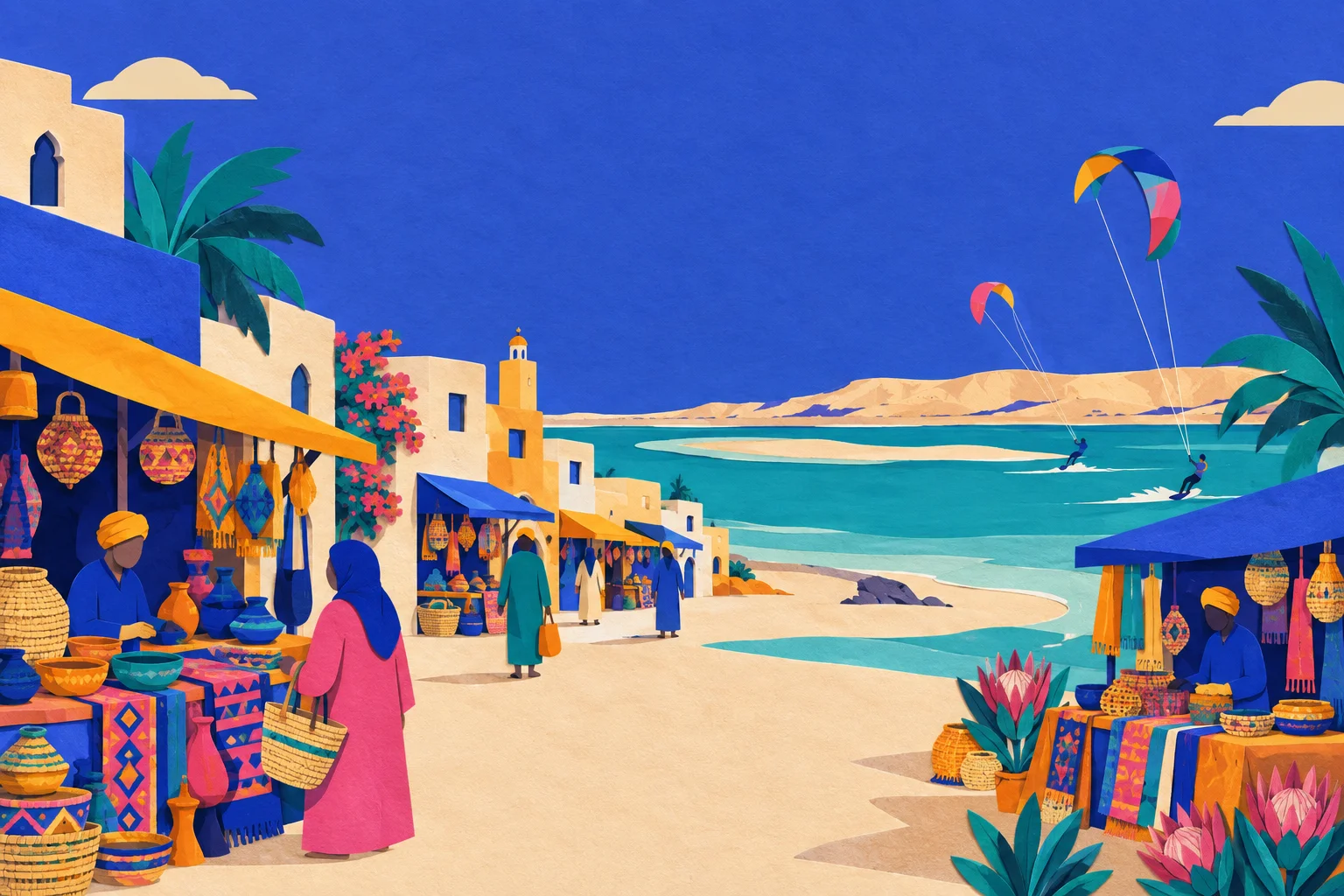
Where Dakhla sits
Dakhla is on the Atlantic coast of southern Morocco, on a narrow peninsula that curls around a shallow lagoon. The town is about 1,400 km south of Casablanca and roughly 500 km south of Laayoune. It has its own airport (Dakhla Airport, code VIL), with domestic flights from Casablanca and seasonal international connections.
The geography is the point. On one side is the open Atlantic; on the other, the lagoon — flat, waist-deep in places, and protected from the swell. That is why wind sports took hold here.
Why people come for the lagoon
The lagoon is one of the most reliable flat-water spots in the region. Wind is strongest in spring and summer, typically from March to September, when the trade winds funnel along the coast. Water temperatures stay mild year-round by Atlantic standards, and the air is warm without being punishing.
Conditions suit different levels:
- Beginners — the northern lagoon has shallow, flat water and several schools.
- Intermediate riders — the southern lagoon offers more space and slightly stronger wind.
- Wingfoil and windfoil — the same flat water works well, and the sport has grown quickly here.
- Surf — outside the lagoon, the Atlantic side has beach breaks that pick up more swell in winter.
If you are planning around wind rather than a fixed date, check seasonal patterns before booking. Our Morocco weather guide explains what the numbers do month by month, including the coastal south.
What a day in Dakhla looks like
Most visitors settle into a rhythm: an early session while the wind is building, a long lunch, then another session in the afternoon. The lagoon is close enough to town that you can move between them easily.
Non-wind days are not wasted. You can:
- Walk or drive along the lagoon's edge and watch the kite schools at work.
- Visit the White Dune (Dune Blanche), a short drive north of town.
- Take a trip to Dragon Island (Île du Dragon), a small island in the bay known for its shape and birdlife.
- Eat seafood in town — Dakhla's fishing fleet supplies it fresh.
The town itself is small and low-key. It is not a resort strip in the Agadir sense; the appeal is the water and the space. If you want a broader look at Morocco's coast, our Morocco beaches guide covers surf, wind and quiet stretches elsewhere.
Getting there and around
Dakhla Airport (VIL) is a short drive from the town centre and the lagoon camps. Domestic flights from Casablanca are the usual route; some European charter and seasonal services also operate.
On the ground, taxis and pre-arranged transfers are the norm. There is no meaningful public transport network for visitors, and the lagoon spreads over several kilometres, so most people arrange transport through their accommodation or kite school. If you are combining Dakhla with a wider Morocco trip, plan the internal flight early — seats on the Casablanca route fill up in high season.
Mobile coverage and data in Dakhla
Morocco's three main networks — Maroc Telecom, Orange and inwi — all operate in the Dakhla area. Coverage in town and around the lagoon is generally usable for messaging, maps and checking wind forecasts. Expect the usual coastal variables: signal can be weaker at the far ends of the lagoon or out on the water, and speeds are not the same as in Casablanca or Marrakech.
For a detailed regional picture, see our Morocco network coverage guide, which breaks coverage down by area.
eSIM or local SIM?
If your phone supports eSIM, you can buy a Morocco data plan before you fly and activate it when you land. That avoids the airport queue and the paperwork that comes with a local SIM. A local SIM can still make sense if you need a Moroccan number for calls, or if you are staying long enough to want a local contract.
Our eSIM for Morocco guide compares the two options in detail. If you are not sure how much data you need for a kite trip — maps, forecasts, messaging, the occasional upload — our data guide helps you estimate.
What to check before you go
- Phone compatibility — not every phone supports eSIM. Check the phone compatibility page before buying.
- Installation — install the eSIM on home Wi-Fi before departure, not at the airport. Our eSIM QR code guide walks through the scan and setup.
- Activation — activate when you arrive so your plan's validity starts on landing.
- Roaming settings — keep your home SIM for calls if you need it, and set the eSIM as your data line. Our dual-SIM WhatsApp guide explains how to keep messaging working across two lines.
When to go
| Season | Wind | Water | Crowds | Best for |
|---|---|---|---|---|
| March–May | Strong, building | Mild | Moderate | Kitesurf, wingfoil |
| June–August | Strongest | Warmest | Busiest | Wind sports, warm water |
| September–November | Still good, easing | Mild | Quieter | Wind sports, fewer people |
| December–February | Lighter | Cooler | Quiet | Surf on the Atlantic side, escape from winter |
If your trip is built around wind, aim for spring or summer. If you want a quieter lagoon and are flexible about sessions, autumn is a good compromise.
Practical notes
- Currency — Moroccan dirham. Cash is useful in Dakhla; not every small business takes cards.
- Language — Arabic and Amazigh are official; French is widely used, and English is common in kite schools.
- Sun and wind — the combination is deceptive. Use high-factor sunscreen and a rash vest; windburn is real.
- Water — the lagoon is shallow and warm, but the Atlantic side has currents. Follow local advice.
- Health — standard travel precautions apply. Check your own government's current advice for Morocco before you travel.
Staying connected without the hassle
Dakhla is a place where you will want your phone for forecasts, messages and the occasional photo upload. Sorting your data before you fly means one less thing to do on arrival. If you are travelling on to other destinations, our Africa eSIM guide explains how one plan can work across Morocco, Egypt and South Africa.