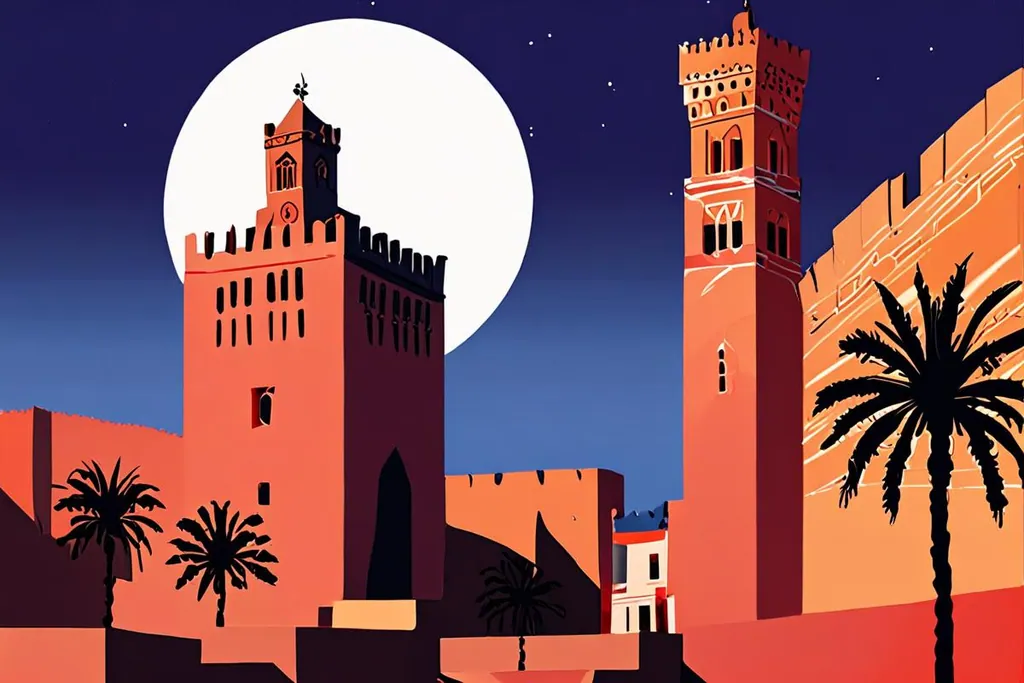
Marrakech was founded around 1070 as the capital of the Almoravid dynasty, and it has been a place people arrive at ever since: traders crossing the Sahara, pilgrims visiting the tombs of the city’s seven patron saints, French painters and rock stars in the 1960s, and now roughly two million visitors a year.
That history is why the city feels like several cities. It also explains the two things most visitors spend the first day working out: how to move between those parts, and how to stay connected while they do it.
- Dân số, điều tra năm 2024
- 996,643
- Năm thành lập thành phố
- 1070
- Tháp Koutoubia
- 77 m
- Từ sân bay đến trung tâm
- 3 km
A city of four parts
The medina is the walled old town, and it is the part you have seen photographs of. Its red walls run about nineteen kilometres around it, built from clay and chalk, which is where the nickname the Red City comes from. Inside is a maze of lanes, some eighteen souks and more than forty thousand people working in crafts. UNESCO listed the medina in 1985.
Gueliz and Hivernage are the new town, laid out outside the walls on wide avenues during the French protectorate. This is where you find international shops, galleries, wine shops, patisseries and most of the city’s modern hotels. It looks and behaves like a European city.
The Palmeraie is a palm oasis on the northern edge, where the resort hotels and golf courses are. And the fourth part is not really in the city at all: the road south to the Atlas, which is close enough for a day trip and visible on a clear day from the rooftops.
When to go: heat, rain and light
Marrakech is hot and dry, and the shape of the year is simple. Spring and autumn give warm days and cool evenings. Winter is mild by day and cold at night, with the Atlas snow visible behind the city. Summer is genuinely severe.
The records from the airport station show what that means in numbers. Average daily highs run from 19 degrees in January to 37.7 in July, and the city has recorded 49.6 degrees. Rain is scarce, about 221 millimetres in a year, and the sunniest month is July.
The practical consequence is that the sightseeing day changes with the season. Between June and September, the medina is at its emptiest and most bearable before nine in the morning and after six in the evening, and the middle of the day belongs to air conditioning, a hammam or a siesta.
Arriving and getting around
Marrakesh Menara airport is about three kilometres southwest of the centre, which is close enough that the transfer is short and far enough that walking it with luggage in August is a bad idea. Its two terminals share a capacity of about four and a half million passengers a year.
Taxis are the default way in. Agree the fare before you get in, because the meter is not always used for airport runs, and keep small notes. The bus is cheaper and slower. Once you are in the city, the BRT bus rapid transit line opened in 2017 and runs on its own route, which makes it more predictable than the traffic.
The medina itself is a walking place. Cars cannot reach most of it, and a driver will often stop at a gate and point you in. This is where a working phone earns its keep, because a pin on a map in a lane with no street signs is the difference between ten minutes and forty.
For the rest of the country, the railway station connects Marrakech to Casablanca, Rabat, Fez, Meknes and Tangier, and the A7 toll motorway runs north to Casablanca in about 210 kilometres and southwest to Agadir in about 233.
Staying online: maps, taxis and messages
Data matters here more than in most cities, because so much of the day depends on it: the map that gets you out of the souk, the ride-hailing app that avoids a fare argument, the translation that settles a price, the photograph you send home.
Morocco has good mobile coverage in the cities and along the main roads, and Marrakech is well served. The question is only how you buy it. Your own operator’s roaming pass is the simplest option and often the most expensive over a week. A local SIM is cheaper but costs you a trip to a shop and a registration process. A travel eSIM is installed before you leave and switched on when you land.
Whichever you choose, the medina’s walls are thick and its lanes are narrow, so expect the signal to dip in the deepest parts of the old town and to be reliable everywhere else, including Gueliz, the Palmeraie and the road to the Atlas.
Bạn sẽ truy cập mạng như thế nào?
Bạn có cần nghe gọi và nhắn tin giữ số của mình khi đi du lịch không?
Gói chuyển vùng của bạn có rẻ hơn khoảng năm đô mỗi ngày không?
eSIM du lịch chỉ dùng dữ liệu
Cài đặt trước khi bay, chuyển dữ liệu sang eSIM khi vừa hạ cánh. Bản đồ, app gọi xe và dịch thuật hoạt động ngay, số điện thoại cũ vẫn giữ nguyên.
Sử dụng số điện thoại của bạn, bật chuyển vùng
Nếu gói chuyển vùng rẻ và đi ngắn ngày, đây là lựa chọn đơn giản. Tuy nhiên hãy tắt dữ liệu di động cho các ứng dụng không cần thiết, vì đồng bộ tự động ở medina có thể dùng hết dung lượng ngày.
What things cost and how to pay
The city runs on cash. Notes, not cards, in the souks, in the small cafes, in the taxis and at the food stalls on Jemaa el-Fnaa. Keep small denominations, because asking a stallholder to break a large note is a negotiation of its own.
Haggling is expected in the souks and it is not rudeness, it is the transaction. In shops with fixed prices, in pharmacies and in the modern supermarkets, it is not. Tipping is a normal part of daily life, a few dirhams for a guide, a baggage handler or a waiter, and the expectation is modest rather than exact.
Budget travellers and luxury travellers both exist here, often in the same square, and the difference is mostly where you sleep and eat rather than what you see.
Where to sleep
The choice that shapes a trip is not hotel versus hostel but medina versus new town.
A riad inside the walls gives you the city at your doorstep and quiet courtyards behind a heavy door, at the cost of getting your luggage to it through lanes and being woken by the call to prayer. A hotel in Gueliz or Hivernage gives you space, parking, a pool and easy taxis, at the cost of a taxi ride whenever you want the souks.
Families and anyone with limited mobility tend to be happier outside the walls. Anyone who wants the medina to be the trip tends to be happier inside it, and should check how far the nearest vehicle access really is.
Days out of the city
Three directions, each short enough for a day.
South, the Ourika valley and the villages below Toubkal are the closest mountains, green along the river and cold in winter. West, the Agafay desert is stony rather than sandy and closer than the Sahara, which makes it a sunset rather than a journey. And the coast at Essaouira is about two and a half hours by road, with wind, fishing boats and a walled town that is quieter than this one.
A word on the activities the Foreign, Commonwealth and Development Office singles out in its advice: quad bikes, electric scooters, hot air balloons and adventure tourism all carry risk that insurance may not cover, so check the policy before you book rather than after.
Trước khi hạ cánh
0/8
Marrakech rewards a slow first day. Walk the walls, find the square before dark, eat where the menus are in one language only, and let the medina teach you its geography. The rest of the city, and the mountains behind it, will still be there tomorrow.