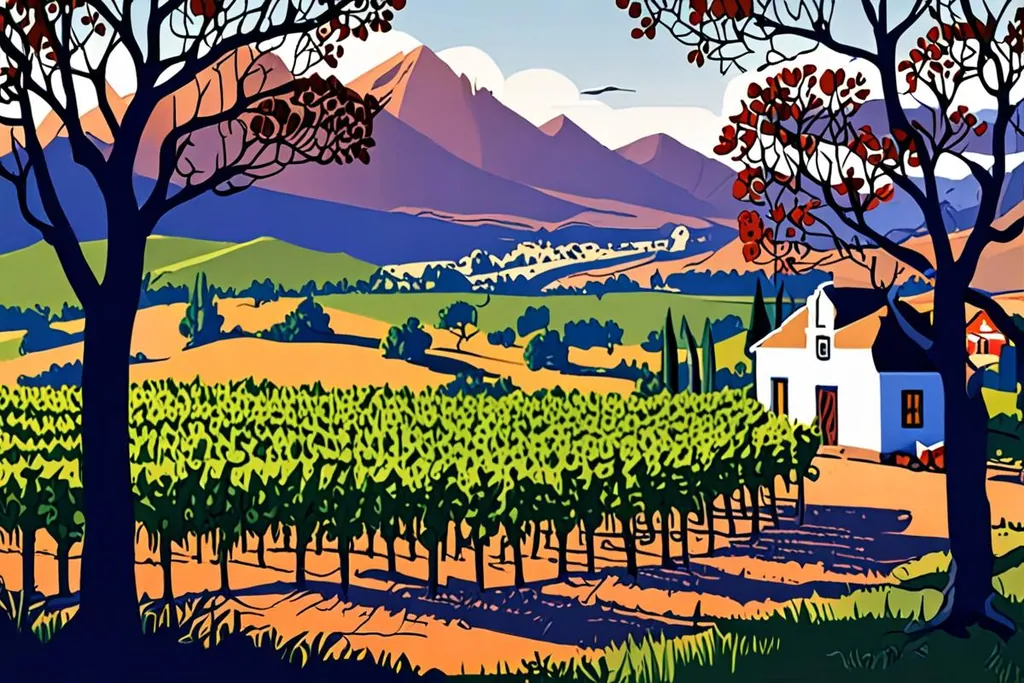
South Africa has been making wine since 1659, when Jan van Riebeeck, the first governor of the Cape settlement, produced the first bottle in Cape Town. Almost all of the country’s wine still comes from one province, the Western Cape, and most of it from within an hour or two of the city: Constantia in the southern suburbs, Durbanville and Paarl to the north, Stellenbosch and Franschhoek to the east, and then the cooler districts of Elgin, Walker Bay and the Swartland further out.
What makes South African wine easy to buy and hard to summarise is the labelling. The Wine of Origin system, introduced in 1973, certifies where a wine’s grapes were grown, in a hierarchy of regions, districts and wards, so a bottle can tell you exactly which valley it came from. It is one of the better labelling systems in the world, and it means you can learn what you like by district rather than by brand.
- The first Cape wine
- 1659
- Wine of Origin introduced
- 1973
- Appellations in the system
- About 60
- Pinotage was bred
- 1925
The grapes to know
Chenin Blanc is the workhorse and the triumph: the most widely planted white grape in the country, capable of everything from a cheap quaffing white to wine that ages for a decade. If you taste one thing in the Cape, taste a serious old-vine Chenin.
Sauvignon Blanc and Chardonnay are at their strongest in the cooler coastal districts, Elgin and Hemel-en-Aarde especially, and Pinot Noir from the same places has become the country’s quiet success. Cabernet Sauvignon and Syrah are the serious reds of Stellenbosch, Paarl and the Swartland, and Syrah has a strong claim to being the variety that suits the Cape’s climate most completely.
Then Pinotage, bred here in 1925 from Pinot Noir and Cinsaut and planted almost nowhere else. It is soft, smoky and sweet when made simply, serious and structured when made well, and it divides every tasting room you walk into. Try one glass, form an opinion, and do not let it stand for the whole country.
The regions, briefly
Stellenbosch is the centre: the largest concentration of estates, the university that trained the winemakers, and the widest range of styles. Paarl and Franschhoek sit either side of it, the second with the better restaurant strip. Constantia, inside Cape Town, is the historic valley. Robertson and the Breede River inland give value and good Chardonnay. Elgin, Walker Bay and Hemel-en-Aarde are the cool south eastern districts. And the Swartland, north of Cape Town, is the newer country of old vines, wild fermentation and Mediterranean varieties.
Tasting rooms, and how the day is shaped
A tasting room in the Cape is a shop, a bar and a small lecture at the same time. You are given a list, usually with six or eight wines on it, and a choice between a standard flight and a premium one; a member of staff pours, explains and answers questions, and the fee is charged per person and often discounted against any bottle you buy. Bigger estates run seated, hosted tastings with a sommelier for a higher fee, and those are worth reserving when you care about the cellar rather than the view.
Some practical notes from the tasting rooms themselves. The staff are used to people who are not driving and to people who are, so spitting is normal and spittoons are provided; nobody will be offended and nobody will be impressed if you swallow everything. Tasting rooms tend to close in the late afternoon, while the restaurants on the same estates run into the evening, which means the last hour is for food rather than for wine.
Ask about the vintage before you buy a case. Cape vintages vary more than the marketing suggests, and a wine you loved on a farm in March may be the same label and a different experience three years later, which is an argument for tasting before committing and for buying what you drank rather than what you remember.
Cap Classique deserves its own paragraph: the Cape’s bottle-fermented sparkling wine is made by the same method as champagne, from Chenin Blanc, Chardonnay and Pinot Noir, and costs a fraction of the equivalent French bottle. It is the most reliable bargain in the country and the thing to take home if you have room for only one case.
How the Cape learned to make wine
1659
The first bottle
Jan van Riebeeck, the founder and first governor of the Cape settlement, produced the first wine in Cape Town, planting the vines that the Dutch needed to supply their ships. Constantia, south of the city, was the first estate to become famous, and its sweet wine was exported to Europe in the eighteenth century.
1973
Wine of Origin
The Wine of Origin system arrived, dividing the growing area into regions, districts and wards and certifying that a wine’s grapes came from the place on the label. It gave producers a way to distinguish themselves by origin rather than by brand, and it is the reason the labels in South Africa are more informative than in most countries.
1990s
The industry opens up
The end of the co-operative marketing era and the return of South Africa to international markets changed the industry completely: new investment, new plantings, exports at scale and a rush of new estates. The wines that filled supermarket shelves abroad in the 2000s were the first result, and the quality that followed is the second.
2000s onwards
The Swartland and the old vines
A movement of younger winemakers looked north to the Swartland and to the Cape’s stock of old, unirrigated bush vines, making wines with wild fermentation and Rhône varieties. It gave South Africa a contemporary identity to sit alongside its established one, and it is the reason a wine list here now looks like a wine list anywhere.
Buying it, and getting it home
Buying it, and getting it home
At the farm gate wine costs far less than the same bottle does abroad, and tasting fees are often discounted against a purchase, which is a good reason to buy as you go rather than later at the airport. The catches are weight and rules: work out your airline allowance and your own country’s duty-free limit before you fill a case, and remember that spirits and fortified wines are counted separately in most places.
Packing is the practical problem. Bottle protectors or thick socks, two bottles to a layer, a hard case for anything more than a handful, and a shipping option from the estate if you have fallen for something you cannot carry. Ask about shipping at the tasting room, because plenty of estates do it and the paperwork is easier than carrying thirteen kilograms of glass through an airport.
How will you taste it?
Are you staying in Cape Town rather than the winelands?
Do you have two days or more for wine?
One afternoon, inside the city
The Constantia valley is inside Cape Town, twenty minutes from the centre, with historic estates, a dessert wine that was famous in eighteenth century Europe, and restaurants on the farms. It is the answer for a half day rather than a day, and it needs a booked car or a ride-hailing round trip.
One day in Stellenbosch or Franschhoek
Thirty estates within a short drive, a booked driver, three or four tastings and a long lunch. This is the standard version of the Cape wine day and it is excellent, provided you choose one valley and stay in it. Book the lunch, and check the tasting room closing times before you set off.
Two days, two valleys
Stellenbosch and its neighbours on day one, and then either the Swartland to the north or Elgin and Hemel-en-Aarde to the south east on day two, which are completely different wine countries: One warm, dry region shaped by Mediterranean varieties, and one cool coastal region with the finest Chardonnay and Pinot Noir in the country. Stay a night in the winelands rather than driving back.
Before a tasting day
0/8
South African wine is a two-hour conversation with a driver in it, and the country has spent thirty years catching up with its own history. Learn Chenin, try Pinotage, buy at the farm, and treat the cool coastal districts as the surprise of the trip.