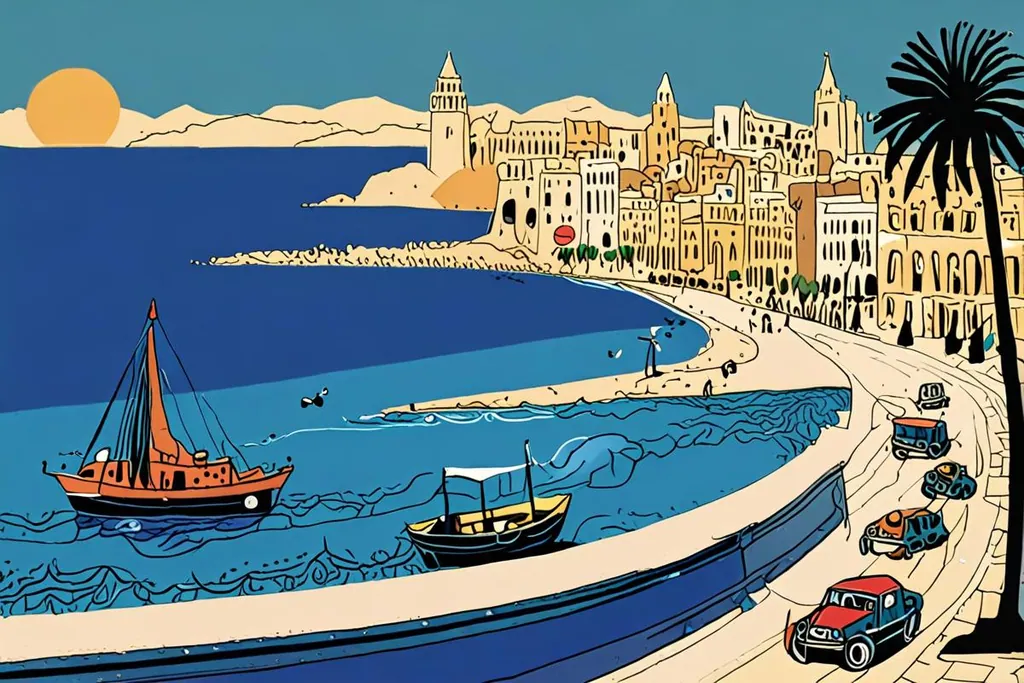
Alexandria is the least Egyptian city in Egypt and has been since the day it was founded. Alexander the Great laid it out in April 331 BC on the site of a fishing village called Rhacotis, with a causeway out to the island of Pharos that gave the city two harbours, and his general Ptolemy made it the capital of Egypt and moved Alexander’s body there. Within a century it was the largest city in the world, and for several more it was second only to Rome.
What is here now is a long city rather than a deep one: about 5.4 million people spread along 40 kilometres of Mediterranean coast at the western edge of the delta, an Italianate downtown, a corniche that is the city’s living room, and a sea that has taken most of the ancient city with it. The two monuments everybody knows, the library and the lighthouse, are both gone, and the modern city has built replacements for one and a fortress over the other.
- Founded by Alexander
- 331 BC
- People in the city, 2023
- 5.4 million
- Height of the lost lighthouse
- 138 m
- Rain in a year
- 211 mm
A Greek city that kept its name
The Ptolemaic city was Greek in its institutions and mixed in its population, divided between the Egyptian quarter of Rhakotis, the royal Greek quarter and a Jewish quarter, with two colonnaded main streets crossing at the point where Alexander’s tomb is thought to have stood. It was the intellectual capital of the Hellenistic world: the library and the Musaeum, the ancestor of the modern museum, drew scholars from across the Mediterranean, and the Septuagint, the Greek translation of the Hebrew scriptures, was made here.
It stayed the capital of Egypt until the Arabs took it in 641 after a siege of fourteen months, and the new capital at Fustat, which grew into Cairo, ended its political life. It declined, revived as the country’s main port in the Middle Ages, declined again when the Portuguese found the sea route to India, and came back in the nineteenth century after Muhammad Ali cut the Mahmoudiyah Canal and reconnected it to the Nile. The cosmopolitan city of the early twentieth century, Greek and Italian and Levantine, was largely emptied by the nationalisations after 1956.
The library and the lighthouse
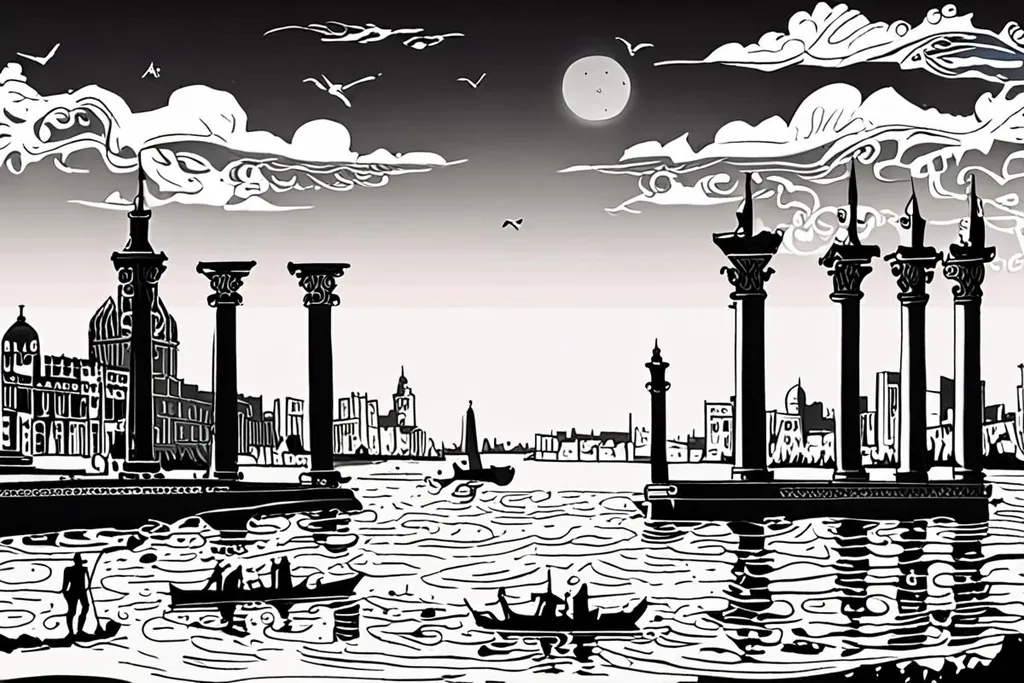
The Great Library is a hole in history. It was probably founded in the early third century BC under Ptolemy II, was part of a complex that included the temple of the Muses, and was damaged or destroyed in more than one fire, with the details still argued over. The Bibliotheca Alexandrina opened in 2002 near the same ground: a modern library rather than a reconstruction, with a great tilted reading room, museums under it and a planetarium beside it, and it is the one piece of contemporary Egyptian architecture that everyone agrees about.
The lighthouse has a better ending, in the sense that we know where it was. The Pharos was about 138 metres tall, begun by the first Ptolemy and finished by the second at a cost of 800 talents over twelve years, and it was the prototype for every lighthouse built afterwards. It stood for more than a thousand years, was already partly ruined when Ibn Battuta visited it in 1326, and was brought down by an earthquake in the fourteenth century. In 1477 the Mamluk sultan Qaitbay built a fortress on the exact spot, using some of the fallen stone, and the Citadel of Qaitbay faces the sea there today.
Under the city, and under the sea
Almost everything ancient in Alexandria is buried, because the modern city stands directly on top of it and there is nowhere to dig. What has been excavated is worth the trouble: the catacombs of Kom El Shoqafa, found by accident in 1900 and reached down a spiral staircase, with three levels of chambers mixing Egyptian, Greek and Roman funeral imagery; Pompey’s Pillar, a single piece of red granite 27 metres high on its pedestal, which has nothing to do with Pompey; and Kom El Deka, where the Roman theatre and baths are still being uncovered.
Then there is the harbour. Cleopatra’s royal quarter went under in earthquakes and subsidence, and since 1992 a French team has been working the sea bed there, raising statues and mapping the palace district and a temple to Isis on the sunken island of Antirhodos. Parts of the port have been opened to visitors in one form or another, which remains a subject of argument among archaeologists.
The city and the sea
Alexandria is one of the most vulnerable large cities in the world to sea level rise, and this is not a future problem. The city is flat, low and built on delta sediment, parts of the centre are already below sea level, and the groundwater that comes with a rising sea is reaching foundations: a 2025 study put more than seven thousand buildings at risk of collapse from that alone. Winter storms and heavy rain already flood streets that were never designed to drain them.
For a visitor this changes nothing about the day and everything about the mood. The corniche is the front line, the fishing boats tie up against a sea that is slowly taking the ground, and the wind off the water is the reason the city is cooler, greener and easier to walk than the rest of Egypt.
Getting there, and getting around
The train from Cairo is the way to arrive: two intercity stations, Misr in the west and Sidi Gaber in the east, both served by Egyptian National Railways, with fast trains taking a couple of hours from Ramses Station. The airport is 25 kilometres out and handles mostly domestic and seasonal traffic, so most visitors come by rail.
Inside the city, the tram is the tradition and one of the survivors: a network built in 1860, the oldest in Africa, running from El Raml in the west to Victoria in the east, with a commuter rail line alongside it to Abu Qir. There are around a hundred bus routes, which are cheap and crowded, and the corniche itself is about 17 kilometres of seafront that is easier taken in pieces than at once. A metro has been planned for years at a cost of about a billion dollars; for now the tram and the taxis do the work.
How will you get online?
Do you need calls and texts on your own number while you are in Egypt?
Is your operator’s roaming pass cheaper than about five dollars a day?
A travel eSIM for data
Install it at home and move data to the eSIM line on landing. The train timetable, the tram map and the ride back from Montaza in the evening all want a connection, and a city stretched along forty kilometres of coast is a bad place to be without one.
Your own line, roaming on
If the pass is cheap and the trip is short, this is one less thing to arrange. Turn data roaming off for everything you do not need, because a phone syncing photographs over hotel wifi of a doubtful quality will find the mobile allowance instead.
Before the train north
0/8
Alexandria is not Luxor or Cairo and should not be judged as either. It is a port city that happens to sit on top of a lost one: eat fish by the harbour, ride the tram, walk the corniche at dusk when the whole city seems to be out doing the same thing, and accept that the famous library and the famous lighthouse are both stories now rather than buildings.