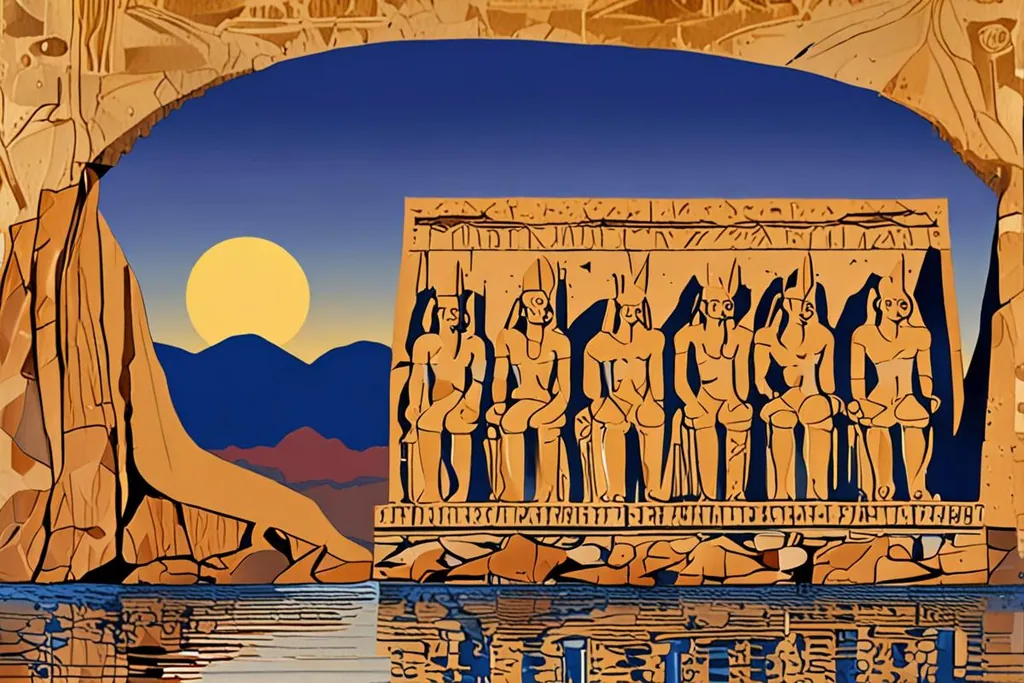
Abu Simbel is two temples cut into a cliff beside Lake Nasser, a few hours south of Aswan and not far from the border with Sudan, and it is the one monument in Egypt that no photograph prepares you for. Four seated figures of Ramesses II look east over the water, twenty metres from base to crown, with a frieze of twenty-two baboons above them greeting the rising sun. Beside them, a hundred metres away, is a smaller temple where the king and his queen stand at exactly the same height, which in Egyptian art is close to a scandal.
The site sits just south of the Tropic of Cancer, on the western bank of the lake, about 230 kilometres south west of Aswan as the crow flies and roughly 300 by road. Nobody passes through on the way to somewhere else. That is the whole practical question about Abu Simbel: how to get there, and how much of a day to give it.
- Chiều cao mỗi tượng thần ngồi
- 20 m
- Chiều cao mặt tiền đền
- 33 m
- Số khối khi di dời
- 1,036
- Từ Aswan, theo đường bay
- 230 km
Two temples in one cliff
The Great Temple was dedicated to Amun, Ra-Horakhty and Ptah, and to Ramesses himself as a god, which is the sort of thing Ramesses did. Construction started in about 1264 BC and took some twenty years. The facade is 33 metres high and 38 wide, carrying the four colossi, and the second figure from the left lost its head and torso in an earthquake shortly after the temple was finished. When the temple was moved, the decision was to leave the fallen pieces where they had come to rest, at the statue’s feet, rather than glue the pharaoh back together.
Inside, the layout follows the usual Egyptian plan of rooms shrinking towards the sanctuary, with an unusual number of side chambers. The hypostyle hall is 18 metres long and 16.7 wide, held up by eight pillars carved as Osiris figures of the king, and the walls carry the battle reliefs of Kadesh, with Ramesses in his chariot shooting at men who are already running.
The Small Temple is dedicated to Hathor and to Nefertari, and it is the second temple in Egyptian history to be given to a queen: the first was the one Akhenaten built for Nefertiti. Its statues are a little over ten metres high, and the king and queen are the same size. Everywhere else in Egypt, a queen stood beside her pharaoh and never above his knees.
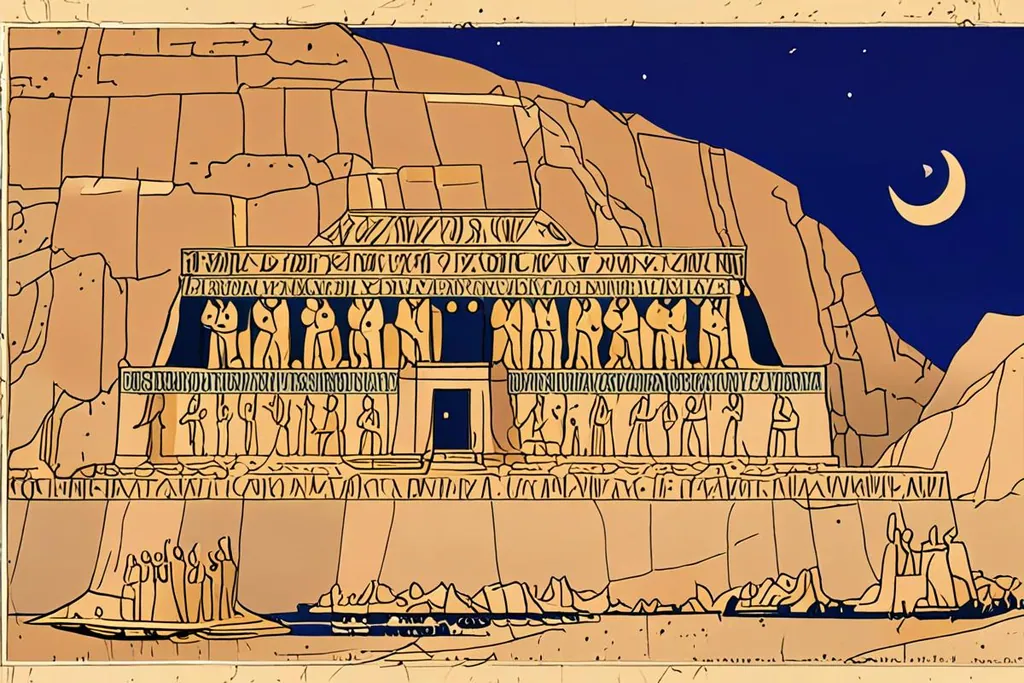
The morning the sun arrives
The axis of the Great Temple was set so that on two days a year the rising sun sends a beam straight down the corridor, 63 metres, into the sanctuary at the back, where it lights three of the four seated figures on the wall: Ra-Horakhty, the deified Ramesses, and Amun-Ra. The fourth, Ptah, is the god of the underworld and stays in the dark, which is either a piece of theology or a piece of stagecraft, and probably both.
Those days are 22 October and 22 February, and they are the reason people book a year ahead for a hotel in Aswan. The dates are usually explained as the king’s birthday and his coronation, though there is no inscription that says so. What is certain is that the effect mattered enough to be rebuilt: the temples were realigned on their new site to preserve it, and the team gathered at sunrise on 22 February 1966 to watch the beam light Amun, Ra and Ramesses while Ptah remained in shadow. Two thousand years of the earth’s axial precession have moved the date since the temple was cut, and the move has shifted it again, so the modern alignment is a good copy rather than the original.
Cuộc giải cứu, theo từng giai đoạn
1959
Một chiến dịch, không phải dự án riêng biệt
Đập cao Aswan sẽ nâng nước hồ lên tới 60 mét ở Abu Simbel, và đá sa thạch bị yếu đi khi ngập nước. UNESCO khởi xướng Chiến dịch Quốc tế để Giải cứu các Di tích Nubia và kêu gọi giải pháp từ toàn cầu.
1962
Ba phương án, chọn một
Một đề xuất giữ nguyên vị trí đền với con đập bê tông cao 73 mét chặn nước. Phương án khác nâng đền bằng kích thủy lực. Đề xuất của công ty Thụy Điển VBB cắt đền thành khối và xây lại trên cao hơn, tiết kiệm được một nửa chi phí.
1963 đến 1964
Đập bao quanh chống nước hồ
Công trình khởi động với đập bao dài 370 mét, cao 25 mét quanh hai đền, xây liên tục ba ca trong ngày và dùng 25 máy bơm rút 750.000 gallon nước mỗi giờ, trong khi các mặt đá được tiêm nhựa epoxy.
1964 đến 1966
1.036 khối đá
Thợ cắt đá Ý, nhiều người đến từ mỏ Carrara, cắt thủ công tại các bề mặt cần ghép khớp. Mỗi khối nặng tới 20 tấn bên trong và 30 tấn ở mặt tiền. Khối đầu tiên được nâng ngày 21 tháng 5 năm 1965 và cuối cùng ngày 16 tháng 4 năm 1966, không khối nào hư hại nghiêm trọng.
1968
Đất cao hơn, và một ngọn đồi nhân tạo
Hai đền được dựng lại cách bờ 208 mét, cao hơn 65 mét, trên các mái vòm bê tông phủ đất đá nhân tạo, sử dụng 300.000 tấn đá mang từ vị trí cũ. Ngày khánh thành là 22 tháng 9 năm 1968, chiến dịch giúp đưa ra Danh sách Di sản Thế giới.
Getting there, and staying the night
Most people come from Aswan, which is the nearest city and the base for the whole of Egyptian Nubia. The road runs about 300 kilometres through open desert; the alternative is a flight into Abu Simbel Airport, two kilometres from the temples, with year-round services from Aswan and seasonal ones from Cairo. Fittingly, the airport was built on the larger of the two storage areas used during the rescue, so you land on the ground where the temple once lay in pieces.
There is not much of a town. Some people stay a night to see the temples twice, at sunset and again at dawn, and to have the place to themselves when the coaches leave; the rest do it as a long half day and sleep in Aswan. Either way, the visit itself is short: an hour or two walking the facades and the interiors, more if you sit and let the scale settle.
Staying online
This is the most remote place on the usual Egyptian circuit, and the one where a downloaded map and an offline ticket matter. Data works in Aswan and along the road, and coverage at the temples is patchy by any standard, so arrange everything before you leave the city: the booking, the map, the message home.
The choice is the same as anywhere in Egypt, and it favours the eSIM here more than it does in Cairo. A local SIM means a counter in Aswan on the day you would rather be on the road. Roaming works and costs. An eSIM installed at home is live when the car stops at the gate.
Bạn sẽ đến đó thế nào?
Bạn đã dự định ở lại Aswan chưa?
Bạn có thể đi từ trước lúc bình minh mà không cảm thấy khó chịu không?
Đường bộ từ Aswan, đi sớm
Hành trình mỗi chiều khoảng 300 km qua sa mạc. Nếu đi sớm, bạn sẽ tới nơi khi mặt trời vừa lên và trước các đoàn khách lớn. Nhớ mang nước và đồ ăn nhẹ vì khu vực này không thuận tiện tìm chỗ ăn trưa vào buổi giữa trưa.
Bay đến vào buổi sáng
Sân bay cách đền 2 km, có chuyến bay quanh năm tới Aswan và các chuyến mùa vụ tới Cairo. Hình thức này giúp rút ngắn thời gian di chuyển, phù hợp nếu bạn cần tiết kiệm thời gian hoặc không thích đi ô tô đường dài bốn tiếng.
Đến Aswan trước, rồi quyết định
Nếu bạn chưa ở Aswan, hãy đến đó trước: đây là căn cứ chính cho việc tham quan đền thờ, sông Nile, làng Nubia và đi thuyền. Mọi phương án đến Abu Simbel đều xuất phát từ đây. Bạn có thể đặt tour ngay tại sảnh khách sạn ở Aswan và chọn đi đường bộ hay bay tùy ý.
Trước khi xuống phía nam
0/8
Abu Simbel is the least complicated site in Egypt and the one with the longest journey attached, which is why the arguments about it are never about the temples. Go early, go once, and give it the morning rather than a slot between two other things: the light on those facades is the point, and it does not wait.